Rate yourself by matching skills to USA Pickleball levels and objective stats.
If you want a clear, fair, and honest way to measure progress, you’re in the right place. I’ll show you how to rate yourself in pickleball using trusted standards, simple tests, and real match data. As a coach and league organizer, I’ve helped hundreds of players find their true level. You’ll learn how to rate yourself in pickleball with confidence, and how to move up without guesswork.
What pickleball ratings mean (and why they matter)
Pickleball ratings help you find fair matches, join the right events, and track growth over time. Two systems are common today:
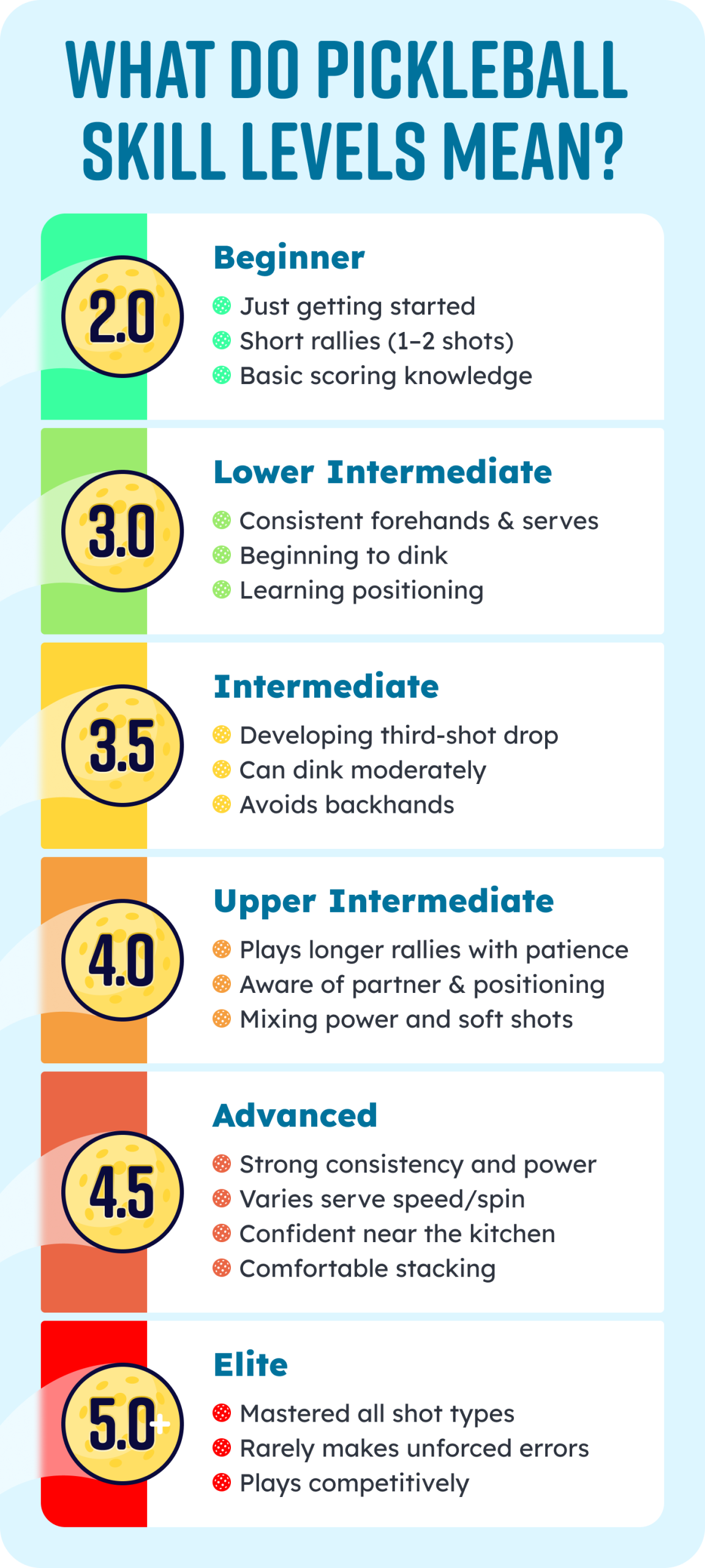
- USA Pickleball Skill Ratings. This is a 1.0 to 5.5+ scale with clear skill traits for each level. It is great for self-rating.
- DUPR (Dynamic Universal Pickleball Rating). This is a data-based rating, about 2.00 to 8.00, built from match results. It updates as you play.
Think of the USA Pickleball rating as your self-check guide. Think of DUPR as your live score that reflects who you play and how you do. Many clubs use both. If you want to learn how to rate yourself in pickleball, start with the USA Pickleball skill traits, then verify with DUPR matches.
Step-by-step: how to rate yourself in pickleball
Use this simple path to self-rate with less bias and more proof.
-
Pick a framework
Choose USA Pickleball skill levels for your first pass. Use DUPR as a cross-check over time. -
Get a baseline video
Record a short session. Include serves, returns, dinks, volleys, third shot drops, resets, drives, and overheads. Film a doubles game to see court movement and shot choices. -
Run simple tests
Use the skill tests below. Log numbers, not feelings. Numbers make how to rate yourself in pickleball much easier. -
Compare to level traits
Read the level checklist. If you meet most of the traits at a level in real play, you likely live there. -
Use the “weakest link” rule
Your rating should not exceed your weakest core pillar. If your third shot drops are 3.0 but all else is 3.5, call yourself 3.0 for now. -
Validate in matches
Play three matches against steady players at the level you think you are. If you hold 50% win rate or better in close games, you fit that level. -
Track with DUPR
Log results in DUPR events, ladders, or rec play that counts. DUPR adds trust to how to rate yourself in pickleball. -
Update every 6–8 weeks
Rating is a snapshot, not a label for life. Re-test after a few training blocks or league cycles.

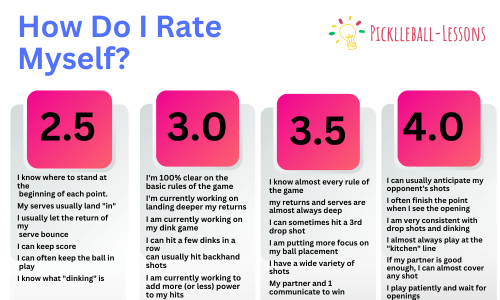
Skill checklist by level (quick self-audit)
Use this as your mirror. Check what you do in real games, not when drilling alone.
2.0–2.5
- You know the rules and can keep score with help.
- Serves and returns land in most of the time, but depth varies.
- Dinks are short and cautious; many pop-ups.
- Volleys are awkward; footwork is basic.
- You avoid the kitchen sometimes but foot fault now and then.
3.0
- Serves and returns are consistent and often deep.
- You can dink crosscourt 5–10 times at slow pace.
- You can hit a third shot drop or drive, but with mixed results.
- You can volley medium speed balls; resets are emerging.
- You see the value of the kitchen line but get pushed off it.
3.5
- You place serves and returns with intent and depth.
- You can dink 10–20 balls with control and some angles.
- Third shot drop lands about half the time under pressure.
- You reset from the midcourt and block fast balls well.
- You use lobs and overheads with decent success.
- You cover the middle in doubles and call shots with your partner.
4.0
- You vary pace: drops, drives, and speed-ups on purpose.
- Dinks have depth, spin, and change of direction; you attack pop-ups.
- Third shot drop lands 60–70% against equal foes.
- You win hands battles with fast, compact volleys.
- You recover to the kitchen fast after resets.
- You apply patterns like drive-then-drop or shake-and-bake.
4.5
- You disguise shots and bait errors with smart patterns.
- Third shot choices adapt to opponents; drop accuracy is high.
- You turn defense to offense with elite resets.
- You control the NVZ line and take time away in hands exchanges.
- You scout opponents live and adjust mid-game.
5.0+
- You operate at pro pace with low errors.
- You create and shut doors fast: pressure, counter, finish.
- Your choices are sound under stress across formats.
- You set up points from the first ball and manage momentum.
If you ask how to rate yourself in pickleball using this list, pick the level where most of your match behavior matches the traits and your weakest key skill is not below it.

Simple tests and numbers you can use today
Use a partner, targets, and a notepad. Repeat each test three times. These numbers are not perfect, but they bring clarity to how to rate yourself in pickleball.
Serve depth test
- Goal: Land serves past the opponent’s baseline hash or within 3 feet of the baseline.
- 20 serves.
- 2.5: 8–10 deep. 3.0: 12–14. 3.5: 15–16. 4.0: 17–18. 4.5+: 19–20 with placement.
Return depth test
- 20 returns against live serves.
- 3.0: 12 deep. 3.5: 14–16 deep. 4.0+: 16–18 deep with placement.
Crosscourt dink count
- Rally with a partner crosscourt. Count clean dinks that land in the kitchen.
- 3.0: 8–12 average. 3.5: 12–20. 4.0: 20–30 with direction changes. 4.5+: 30+ with spin and angles.
Third shot drop accuracy
- 20 drops from baseline to kitchen crosscourt.
- 3.0: 8–10 land soft in the kitchen.
- 3.5: 11–14.
- 4.0: 15–16 with height control.
- 4.5+: 17–20 under light pressure.
Volley block and reset
- Partner feeds at medium pace from NVZ. You block from transition zone (between baseline and NVZ).
- 20 balls.
- 3.0: 8–10 land in. 3.5: 12–14. 4.0: 15–16 with depth. 4.5+: 17–20 with control.
Kitchen time
- In a doubles game to 11, track how many rallies you reach and hold the NVZ line.
- 3.0: Reach and hold in about half of rallies.
- 3.5: Hold in most rallies once you arrive.
- 4.0+: Win most rallies when you get there.
Unforced error rate
- Play two games to 11. Count errors on neutral balls.
- 3.0: 8–10 per game.
- 3.5: 5–7.
- 4.0: 3–4.
- 4.5+: 0–2.
These checks make how to rate yourself in pickleball simple and fair. If your numbers straddle levels, choose the lower one for now, then train to bump them up.
Doubles vs singles: rate each format
Your level can differ by format. That is normal.
- Singles needs more movement, deeper drives, and passing shots. Drops matter less; fitness and serve plus first ball patterns matter more.
- Doubles needs soft hands, resets, and kitchen control. Team talk and court coverage matter a lot.
If you ask how to rate yourself in pickleball for singles, use serve, return, drive, pass, and footwork tests. For doubles, lean on dinks, drops, volleys, resets, and team skills. It is fine to be a 4.0 in doubles and a 3.5 in singles.
Common self-rating mistakes to avoid
Avoid these traps when you figure out how to rate yourself in pickleball.
- Rating by your best day, not your average day. Use typical play, not highlights.
- Ignoring weak links. One weak skill can cap your level against smart foes.
- Skipping defense. Resets and blocks win more at higher levels than big swings.
- Overweighting power. Pace helps, but control and choices set your ceiling.
- Not tracking results. If you do not write it down, you will guess wrong later.
- Only playing friends. Mix in ladders, round robins, and leagues for a clean read.

How to verify and improve your rating fast
Make your rating real and make it rise.
- Log matches in DUPR. Ladders and leagues that report results are gold. Your data will reflect strength of opponents and recency.
- Play “just above” sessions. If you think 3.0, play some 3.5s. Aim for close games. This is the most honest way to see where you fit.
- Drill what moves the needle. Drops, resets, and dink depth raise your ceiling fast. Serve and return depth make every point start better.
- Chart your games. Track unforced errors, winning patterns, and where you stand when you lose rallies. Change one thing per session.
- Get a periodic lesson. A coach can spot small fixes in paddle angle, contact point, and footwork that change everything.
- Build simple fitness. Add quick footwork drills and shoulder care. More balls in position means better shots and fewer errors.
When you focus on these steps, how to rate yourself in pickleball becomes steady and honest. You will see gains and you will know why.

Frequently Asked Questions of how to rate yourself in pickleball
What is the fastest way to find my level?
Use the USA Pickleball checklist, run the tests above, then play three matches vs that level. If games are close and you hold 50% wins, the level fits.
How does DUPR compare to USA Pickleball levels?
DUPR is a results-based number, while USA Pickleball uses skill traits. Many 3.5 players sit around the mid-3s in DUPR, but ranges vary by area.
Can my singles and doubles ratings be different?
Yes, and that is common. Rate each format based on skills and results, then list both on your player profile.
How often should I update my self-rating?
Every 6–8 weeks is a good rhythm. Update sooner if you change partners, train more, or see big jumps in your test numbers.
What if I’m between two levels?
Choose the lower level for now. Train one or two weak links, then re-test and validate in matches before you move up.
Does equipment affect my rating?
Only a little. A good paddle helps, but control, footwork, and choices matter far more for your true level.
Conclusion
You can rate yourself with calm and clarity. Use skill traits, quick tests, and real match data to find your true level. Keep your focus on weak links, not labels, and your rating will rise as your game grows.
Start today. Pick one test, log your numbers, and book a session against the level you aim for. If this guide helped you learn how to rate yourself in pickleball, share it with a partner, subscribe for more tips, or drop your questions in the comments.