
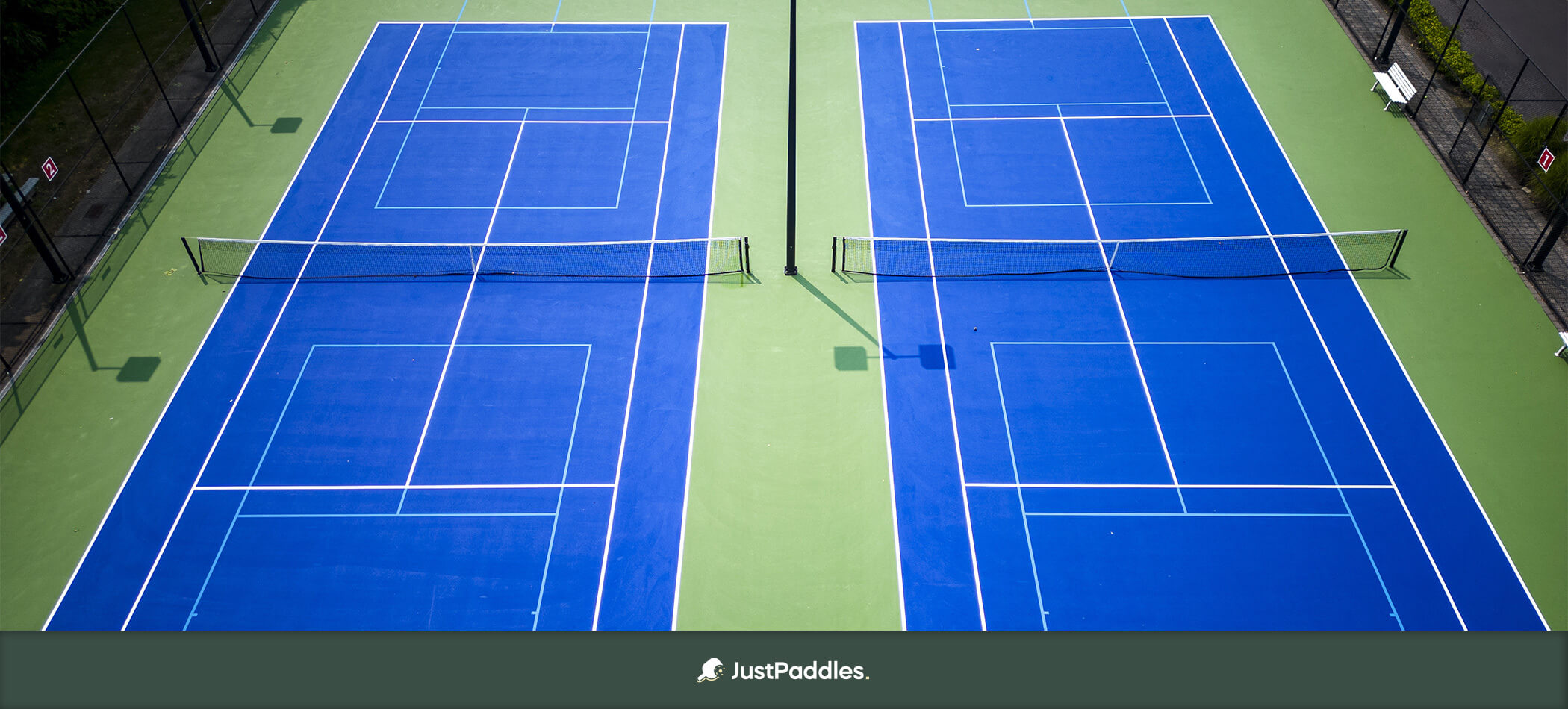
Yes. You can use a tennis court for pickleball with simple adjustments.
If you’re wondering can you use a tennis court for pickleball, you’re in the right place. I’ve helped clubs, HOAs, and neighbors convert courts fast, safe, and on budget. This guide walks you through what works, what to avoid, and how to get great play without drama.
Why a tennis court works for pickleball
A tennis court is big, flat, and already fenced. That makes it great for pickleball. The surface is ideal, and there is room for more than one pickleball court.
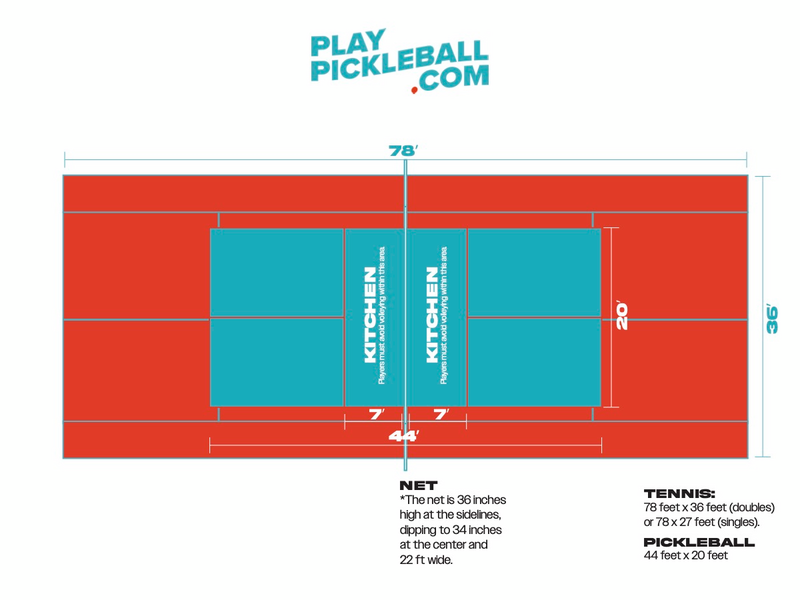
Official pickleball lines form a 20 by 44 foot rectangle. The ideal total space is 34 by 64 feet, including safe run-offs. A tennis court pad is often 120 by 60 feet. So the size fits well. If you ask, can you use a tennis court for pickleball, the short answer is yes, and it is common.
You can place one, two, or even four pickleball courts on one tennis court. It depends on the total pad size and the safety space you have.

Dimensions, markings, and layouts
The key is layout. Mark clean lines, place the nets right, and allow safe margins.
-
Court sizes
- Pickleball playing area: 20 feet wide by 44 feet long.
- Minimum total space per court: 30 by 60 feet.
- Preferred total space per court: 34 by 64 feet.
- Tennis court pad: often 120 by 60 feet.
-
Net heights
- Pickleball net: 34 inches at center, 36 inches at sidelines.
- Tennis net: 36 inches at center, 42 inches at posts.
- You can use a portable pickleball net for perfect height.
- If you must use the tennis net, use a temporary center strap or converter to reach 34 inches. Get permission first.
Common layouts
-
One pickleball court on a tennis court
- Center it across the middle.
- Use the tennis net as a divider if needed.
- Good for practice and small groups.
-
Two pickleball courts on one tennis court
- Place one on each side of the tennis net.
- Rotate them perpendicular to the tennis net to fit run-offs.
- This is the most common setup in parks.
-
Four pickleball courts on one tennis court
- Use the full 120 by 60 foot pad.
- Place two courts on each side.
- Leave walkways between courts for safety.
- This works best with portable nets and clear rules.
-
Line color and contrast
- Use a color that stands out but does not confuse tennis play.
- Blue or yellow tape works well on green courts.
- Keep pickleball lines narrower than tennis lines so players can tell them apart.
If you asked can you use a tennis court for pickleball and still keep tennis, the answer is yes. Use temporary lines and portable nets to share space with no damage.
How to convert a tennis court for pickleball step by step
I have done this many times with community groups. The process is simple when you plan. Here is a clean, repeatable setup.
-
Get permission
- Check with the city, school, club, or HOA.
- Ask about approved tape or paint.
-
Gather tools
- Measuring tape (at least 100 feet).
- Chalk or contractor’s crayon for planning.
- Painter’s tape (blue or green), 1 to 2 inches wide.
- Portable pickleball nets.
- Broom and towel.
-
Measure and mark
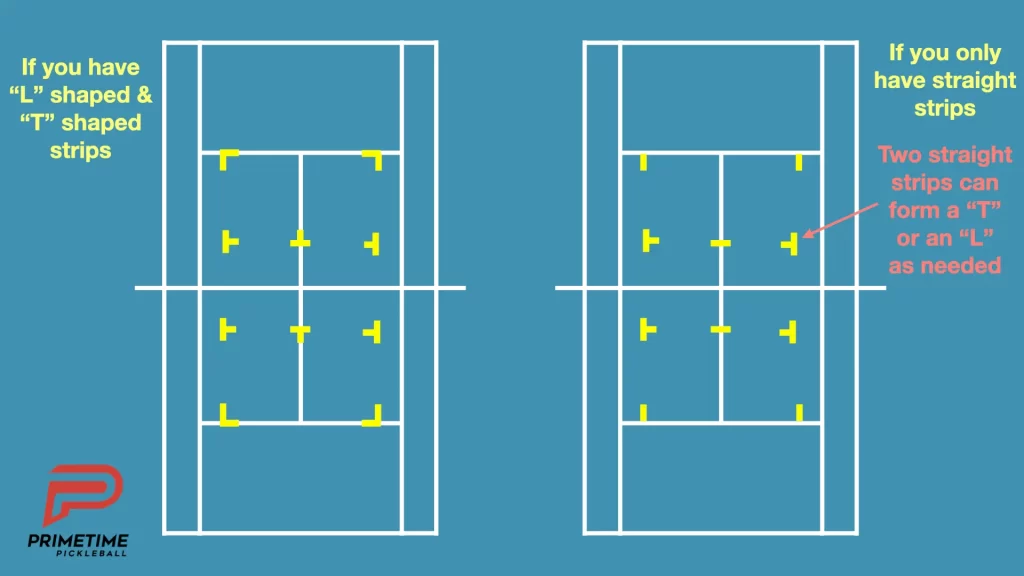
- Outline 20 by 44 feet for each court.
- Leave at least 5 feet behind baselines and 3 feet on the sides.
- Mark non-volley zones (kitchen) 7 feet from the net on both sides.
-
Place nets
- Set the portable net to 34 inches at center.
- Keep nets tight and stable.
- If using the tennis net, add a center strap to lower to 34 inches.
-
Tape lines
- Run baseline, sidelines, centerline, and kitchen lines.
- Press tape edges firmly to avoid trip edges.
- Keep lines straight using a string line or a partner.
-
Safety check
- Sweep grit and leaves.
- Check for cracks or raised tape.
- Confirm spacing to fences and other courts.
-
Post simple signage
- Show where to play and any time limits.
- Remind players to remove tape if required.
Pro tip: On hot days, tape can soften. I like to tape early morning or late afternoon. It lasts longer and sticks cleaner.

Temporary vs permanent solutions
Temporary lines are perfect for shared courts. Permanent paint is best for high demand.
-
Temporary
- Tools: tape, chalk, or throw-down court lines.
- Fast and cheap.
- Best when tennis players also use the court.
- Remove tape after play if rules require it.
- Note: Some tapes leave residue in heat. Test a small spot first.
-
Permanent
- Tools: court paint, stencils, pro installer.
- Costs more but looks great and lasts.
- Best for parks and clubs with steady pickleball use.
- Requires formal approval.
- Add dedicated nets if possible.
Noise matters too. Outdoor pickleball has a sharper pop than tennis. If neighbors are close, set play hours and consider quieter paddles and balls. When people ask can you use a tennis court for pickleball in a neighborhood, I always add a note on sound.
Equipment, safety, and play tips
You do not need much gear, but the right gear helps.
-
Equipment
- Paddle that matches your skill and local rules.
- Outdoor ball if you play outside. It has more holes and stays stable in wind.
- Court shoes with good grip and low tread wear.
-
Safety
- Check tape edges. Trim or press down any bumps.
- Avoid slick chalk on damp mornings.
- Keep bags and water off the court.
- Do not crowd fences. A safe run-off reduces ankle and wrist injuries.
-
Play tips
- Tennis lines can distract new players. Tell your group to use only the taped lines.
- Sun and wind change shots. Rotate ends every game to keep play fair.
- If rallies feel slow, lower the net to 34 inches at center and use a fresh ball.
From my experience, the biggest early mistake is a high net. A two-inch lift at center changes dinks and lobs. Fix that first and the game feels right.

Costs, scheduling, and etiquette
You can start small and scale up as interest grows.
-
Typical costs
- Portable pickleball net: 150 to 250 dollars.
- Painter’s tape and chalk: 10 to 30 dollars.
- Throw-down lines: 25 to 60 dollars.
- Permanent paint and posts: varies a lot. Budget a few thousand for pro work.
-
Scheduling
- Use a sign-up sheet, club app, or shared calendar.
- Block time for tennis and pickleball.
- Rotate courts so new players get turns.
-
Etiquette
- Share the space. Permit holders go first.
- Keep noise respectful near homes.
- Clean up tape and trash.
- Return nets and windscreens as found.
If your group is weighing can you use a tennis court for pickleball and keep peace, clear rules and a schedule solve most issues.

Common mistakes and how to avoid them
I have seen these errors many times. They are easy to fix.
-
Laying courts too close to the fence
- Keep at least 5 feet behind baselines. More is better.
-
Using indoor balls outside
- They fly weird in wind and crack fast. Use outdoor balls.
-
Net too high or too low
- Check 34 inches at center every session.
-
Tape that peels paint or leaves residue
- Test a small area. Remove tape in the shade, not under blazing sun.
-
Confusing line colors
- Pick strong contrast. Keep pickleball lines thinner than tennis lines.
-
Skipping permission
- Always ask first. It keeps your access safe.
These small details decide if can you use a tennis court for pickleball will be a smooth win or a headache.
Frequently Asked Questions of can you use a tennis court for pickleball
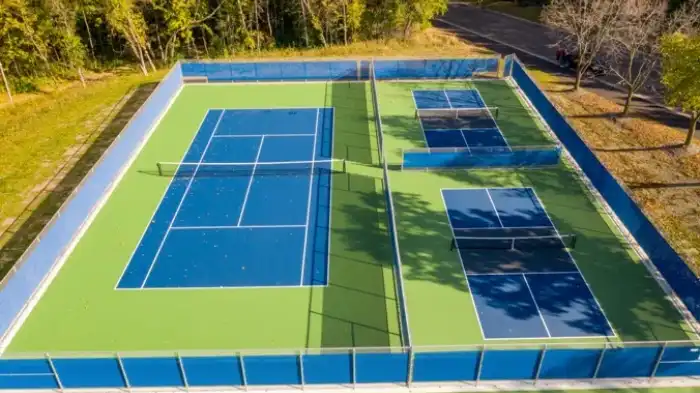
How many pickleball courts fit on one tennis court?
Two courts fit well on most tennis courts with portable nets. In some spaces, you can fit four with safe walkways and proper run-offs.
Can you use a tennis net for pickleball?
Yes, but lower the center to 34 inches with a strap. A portable pickleball net gives the best height and feel.
Do I need permission to add temporary lines?
Usually yes. Parks, schools, and HOAs often have rules on tape and court use. Ask first to avoid fines or loss of access.
Will tape damage the tennis court?
Quality painter’s tape is safe when tested and removed soon after play. Avoid duct tape or cheap tape in high heat.
What is the best way to line a court fast?
Measure once, snap chalk lines, then tape. Two people and a string line make straight lines quick and easy.
Can you use a tennis court for pickleball if others are playing tennis?
Only if there is a schedule and space. Share the court by time blocks or use portable nets on one side when it is safe.
What balls should I use outdoors?
Use outdoor balls with more, smaller holes. They cut wind better and last longer on rough surfaces.
Conclusion
You now know the full picture: can you use a tennis court for pickleball, what it takes, and how to do it well. With the right layout, nets, and clear rules, you can turn any tennis court into a fun, safe pickleball space.
Start small with tape and a portable net this weekend. Test a two-court layout, gather feedback, and improve. Ready to go deeper? Save this guide, share it with your group, and leave a comment with your setup questions or wins.