In pickleball, rate yourself by matching skills to benchmarks and validating with matches.
If you have ever wondered how do you rate yourself in pickleball, you are in the right place. I coach new and mid-level players, and I have helped many find their true level fast. This guide gives you a clear process, skill checklists, and on-court tests. You will learn exactly how do you rate yourself in pickleball and confirm it with real play.

Why Rating Yourself Matters
Your rating opens doors. It helps you join the right open play, leagues, and tournaments. It protects fun and fairness for everyone on court.
A good self-rating speeds up your growth. You face the right mix of challenge and wins. You also track progress with confidence.
If friends ask how do you rate yourself in pickleball, you can now give a clear and fair answer. That helps your club set balanced games.
The Main Rating Systems Explained
There are three common paths. Self-rating, an official tournament rating, and a data rating.
Self-rating is where you start. You match your skills to public level guides. This is used for rec play and entry forms.
Official ratings come from sanctioned events. These often use UTPR. Your result moves your number up or down.
Data ratings use match scores from any play. DUPR is the most known. It tracks who you played and the score spread. This is useful even before tournaments.
All three point to the same goal. Place you at a level where rallies flow, and points feel fair. That is the core of how do you rate yourself in pickleball.
How Do You Rate Yourself in Pickleball: A Step-by-Step Guide
Follow these steps to get a reliable number. This is the simple way for how do you rate yourself in pickleball and to keep it honest.
-
Pick a rating lane
Choose self-rating now. Plan to add DUPR or UTPR later. That gives you proof with real results. -
Score your core skills
Assess serve, return, dinks, volleys, drops, drives, lobs, overheads, footwork, and strategy. Use the level guide below. Mark each skill with the level that fits today. -
Run quick court tests
Use the drills in this guide. Note your make rate and targets. Keep it simple and repeatable. -
Validate with play
Play five to ten games vs known levels. See your game point spread. If you lose close to a level, you may be near that level. -
Set a conservative number
Pick the lowest level that all your core skills can meet. Round down if split. This prevents overrating. -
Recheck monthly
Log drills, matches, and notes. Adjust your number when results prove it. Small moves are best.

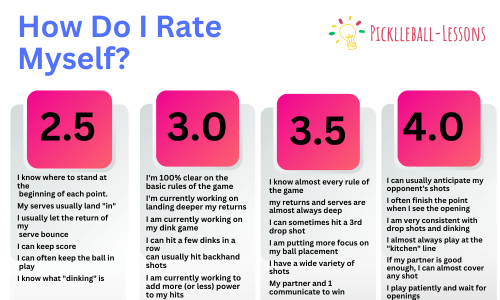
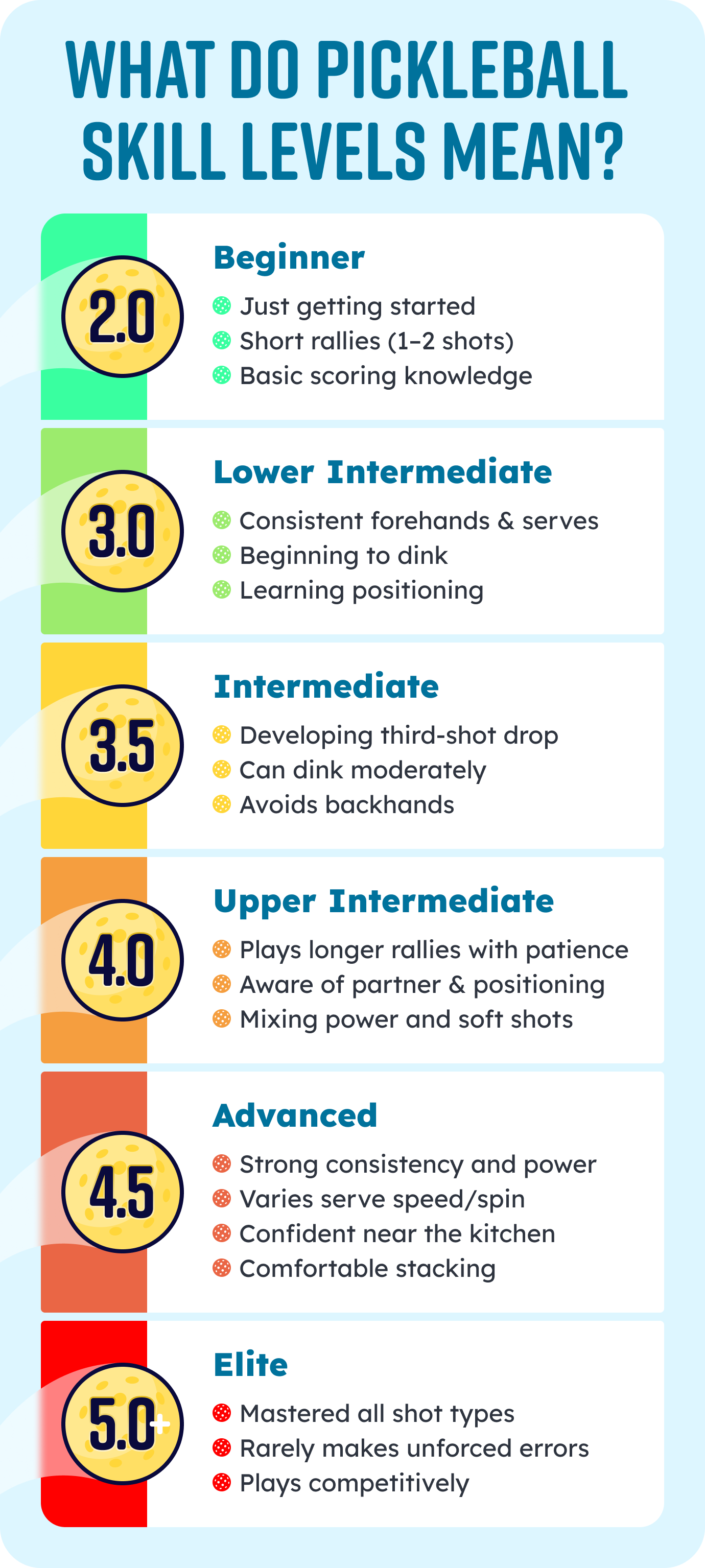
Skill Benchmarks by Level (1.0 to 5.0+)
These summaries reflect common public descriptors and coaching norms. Use them to tag each skill.
1.0–2.0 Beginner
- Serve and return: Can start points most of the time.
- Dinks: Short shots are random. Many balls pop up.
- Volleys: Short control at the net is tough.
- Strategy: Knows basic rules and positions.
- Movement: Learns the Non-Volley Zone.
2.5 Novice
- Serve and return: In play often. Depth is mixed.
- Dinks: Can dink a few in a row on the same side.
- Drops and drives: Tries both. Many errors.
- Volleys: Can block slow balls.
- Strategy: Starting to stack and call shots.
3.0 Developing
- Serve and return: In with fair depth and aim.
- Dinks: 6–10 shot rallies are common in drills.
- Drops: Can land a soft third sometimes.
- Volleys: Can control pace on medium balls.
- Strategy: Starts the soft game and keeps to a plan.
- Movement: Balanced split step. Better recovery.
3.5 Intermediate
- Serve and return: Deep and placed often.
- Dinks: Low and cross-court with intent.
- Drops: Third-shot drop lands more than half the time.
- Drives: Uses pace with fewer errors.
- Volleys: Punches and blocks with aim.
- Strategy: Baits errors and uses resets.
- Movement: Footwork holds up under pressure.
4.0 Advanced
- Serve and return: Mixes spin, pace, and targets.
- Dinks: Changes speed, depth, and angles on purpose.
- Drops: Reliable from both sides and from mid-court.
- Volleys: Fast hands and smart counters.
- Strategy: Builds points with patience and patterns.
- Movement: Reads attacks early and defends lobs well.
- Consistency: Low unforced errors.
4.5 Strong Advanced
- Serve and return: Wins free points with depth and shape.
- Dinks: Attacks only the right balls. Very low pop-ups.
- Drops and resets: Soft control under pressure is steady.
- Volleys: Wins fast hands battles vs peers.
- Strategy: Switches plans mid-rally. Poaches well.
- Movement: Covers court with strong recoveries.
5.0–5.5+ Expert
- Serve and return: Elite depth and deception.
- Dinks: Mastery of spin, disguise, and speed-ups.
- Drops: Lands quality from tough spots.
- Volleys: Dominates hand speed at the kitchen.
- Strategy: Reads patterns, sets traps, and controls pace.
- Movement: Efficient and explosive with few lapses.
Use this as your skill map. Your true level is the lowest level all key skills can meet.
On-Court Self-Tests You Can Do Today
Use these fast tests. Keep score and compare over time.
Serve depth test
- Goal: Land 20 serves past the mid-line.
- 3.0: 12 of 20. 3.5: 15 of 20. 4.0: 17 of 20 with corner aims.
Return depth test
- Goal: Land 20 returns within 5 feet of the baseline.
- 3.0: 10 of 20. 3.5: 12 of 20. 4.0: 15 of 20.
Cross-court dink test
- Rally with a partner cross-court. Count clean dinks.
- 3.0: 10 in a row. 3.5: 20 in a row. 4.0: 30+ with low net height.
Third shot drop test
- Hit 20 drops from the baseline into the kitchen, both sides.
- 3.0: 8 of 20. 3.5: 12 of 20. 4.0: 15+ of 20.
Fast hands volley test
- Stand at NVZ. Partner fires 20 controlled speed-ups at chest to hip.
- 3.5: 10 clean counters. 4.0: 14. 4.5: 17+ with placement.
These drills give numbers you can trust. They also support how do you rate yourself in pickleball with proof.
Common Mistakes When Self-Rating
Rating off your best day
- Use an average day. Big days and bad days both lie.
Ignoring soft skills
- Drops, resets, and dinks decide level. Power alone does not.
Overweighting wins
- A win vs a higher pair may hide a weak link. Look at your role in rallies.
Skipping partner balance
- Your level is not your team’s level. Rate your own actions.
No validation
- Always test your number in real games. Repeat and track.
Avoid these traps to keep your rating fair and trusted.

How to Improve Your Rating Fast and Fair
Work on one weakness at a time. This brings quick gains. It also helps you keep a stable base.
Use a simple weekly plan
- Two drill days for soft skills.
- One match day for pressure reps.
- One video or note review day.
High return on time
- Third-shot drop from both wings.
- Cross-court dink to neutral.
- Transition resets from mid-court.
- Serve and return depth with targets.
Smart play habits
- Aim big targets. Middle wins.
- Fewer speed-ups, better choices.
- Split step, then swing.
- Call patterns with your partner.
These steps raise both skill and trust. That is how do you rate yourself in pickleball and move up with proof.

Tracking Tools, Data, and When to Get an Official Rating
Use a notebook or app to log drills and scores. Note who you played and the spread. Mark unforced errors and winning patterns.
Consider a data rating like DUPR. It uses any play with score and opponents. The more you log, the sharper your number.
Enter one local event when ready. Your nerves will test your base. This is great data for how do you rate yourself in pickleball over time.
Ask a coach or advanced player for a 10-minute audit. A fast outside view saves months.
Frequently Asked Questions of how do you rate yourself in pickleball
How do you rate yourself in pickleball without an official rating?
Match your skills to level benchmarks and run the drills above. Then test in games against known levels and set a conservative number.
Is self-rating accurate enough for league play?
Yes, if you back it with drills and match results. Update it monthly so it reflects your current form.
What counts more, power or soft game?
Soft game wins at mid and high levels. Drops, resets, and dinks keep you in points and set up attacks.
How long does it take to move from 3.0 to 3.5?
With steady drills and two match days a week, many do it in three to six months. Your timeline may vary based on reps and coaching.
Can I use DUPR to confirm my self-rating?
Yes. Log honest scores and opponents. Over 10 to 20 logged games, your number will settle near your true level.
Conclusion
A fair self-rating is simple. Map your skills to clear levels, run a few tests, and verify in real games. Keep notes, adjust slowly, and let your data speak.
Pick one drill and one match habit from this guide today. Do that for two weeks and review your logs. If this helped, share your level journey in the comments and subscribe for weekly pickleball tips.