

A standard pickleball court is 20 feet wide and 44 feet long.
If you came here wondering how wide is a pickleball court, you’re in the right place. I’ve lined courts in gyms, taped driveways, and advised parks on layouts. This guide breaks down court width with clear tips from real play and official standards. Stick around to see why the 20-foot width matters, how to measure it fast, and how to plan space for safe games.
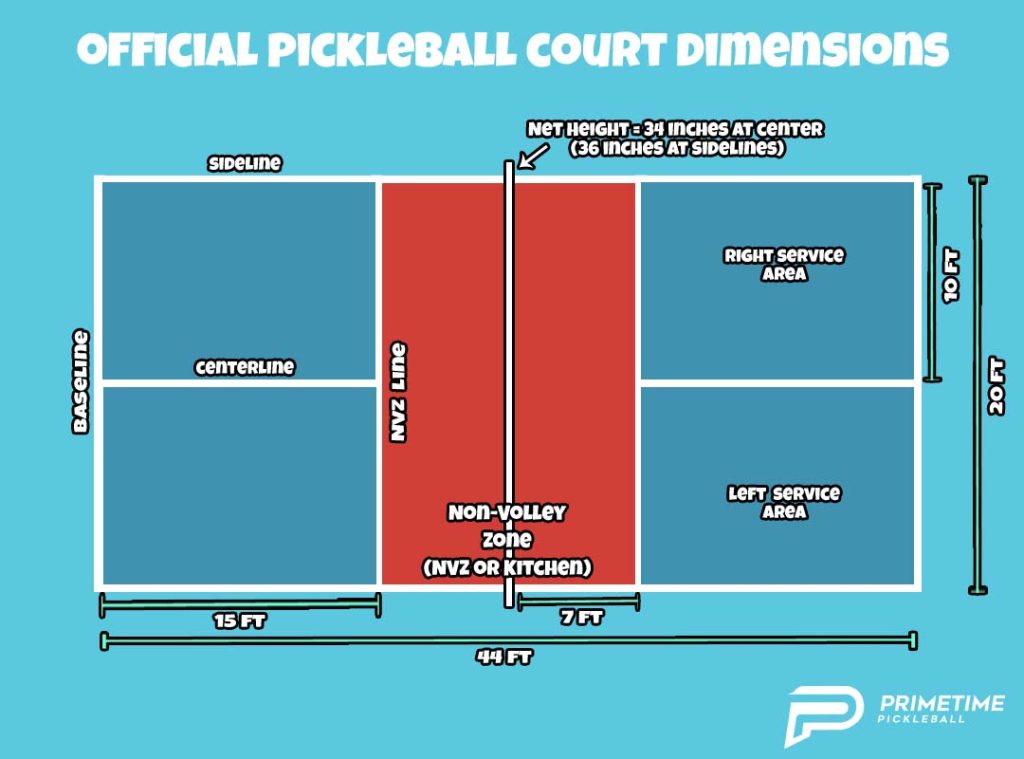
Official Pickleball Court Dimensions at a Glance
Let’s start with the basics. A regulation pickleball court is 20 feet wide and 44 feet long for both singles and doubles. The non-volley zone (the kitchen) is 7 feet from the net on each side. The net stands 36 inches at the posts and dips to 34 inches at the center. The net itself spans about 22 feet, so it anchors just outside the sidelines.
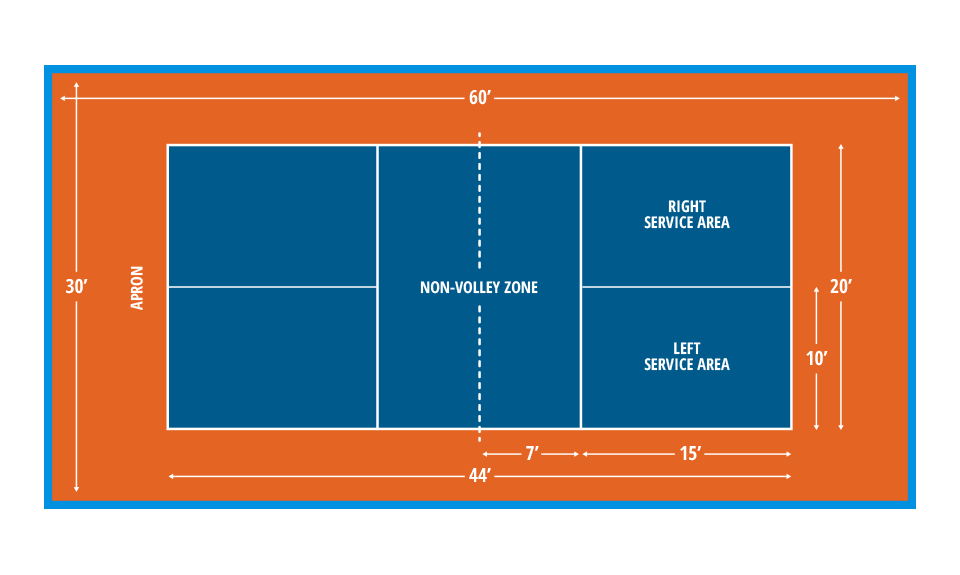
Inside the 20-foot width, each service court is 10 feet wide by 15 feet deep. Lines are 2 inches wide, are part of the court, and all dimensions are measured to the outside edge of the lines. The official minimum play area is 26 by 54 feet. The recommended play area is 30 by 60 feet to allow safe movement.
If you ask how wide is a pickleball court during setup, remember this: keep the playable width at 20 feet, then add side space for safety. The 20-foot width is the same for beginner clinics, rec play, and tournaments.
Width vs. Length: Why 20 Feet Matters
The width defines angles and shot choices. At 20 feet wide, wide cross-court dinks are in reach, and drives must be precise. This width creates fair spacing in doubles while keeping rallies fast and fun.
Players often ask, how wide is a pickleball court when switching from tennis? Tennis courts feel huge by comparison. The 20-foot width tightens gaps, rewards footwork, and makes court positioning key. If you ever wonder how wide is a pickleball court for high-level play, it’s still 20 feet—strategy changes, size doesn’t.
Singles, Doubles, and Surface Type: Does Width Change?
You use the same court for singles and doubles, so the width stays 20 feet. Nothing about the game mode changes the court size. That makes it easy to share courts and run mixed sessions.
Indoor and outdoor courts use the same 20-foot width too. Only the space around the court, lighting, and surface texture vary. If someone asks how wide is a pickleball court indoors vs. outdoors, the answer is still 20 feet.

Space You Need Beyond the Lines
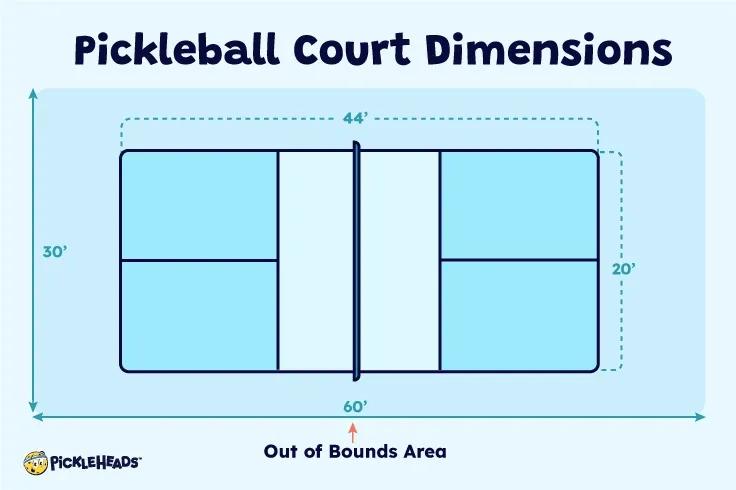
Plan for more than the 20-foot playable width. The recommended play area is 30 feet wide by 60 feet long. That gives about 5 feet of side space and 8 feet behind each baseline. The minimum play area is 26 by 54 feet, which is tight but usable.
For busy clubs and tournaments, many aim for 34 by 64 feet. That gives extra room for lobs, serves, and safe stops near the fence. If you want quick recall of how wide is a pickleball court plus safe clearance, think 30 feet total width with 20 feet to play.

How to Measure, Mark, and Tape a Court
Here’s a simple way I use to set up a fresh court in a gym or driveway.
- Gather tools: 100-foot tape, chalk line, painter’s tape, straight edge, and a rubber mallet.
- Mark the baseline: Snap a straight 20-foot line for the back line.
- Square the court: Use the 3-4-5 method or check the diagonal. The diagonal of a regulation court is about 48 feet 4 inches.
- Measure length: From each baseline corner, measure 44 feet to set the opposite corners.
- Mark sidelines and baselines: Lines are 2 inches wide. Measure to the outside edge.
- Set the non-volley zone: Mark 7 feet from the net line on both sides.
- Divide service courts: Split the 20-foot width down the centerline for two 10-foot-wide service boxes.
- Check width: Ask again, how wide is a pickleball court? Confirm it is 20 feet at both baselines and at the net.
Pro tip from experience: tape lines last, after you snap all chalk lines. It saves rework if a corner is off by an inch.

Converting a Tennis Court or a Driveway
You can fit multiple pickleball courts inside a tennis enclosure. In a full 60 by 120-foot fenced area, four pickleball courts often fit with good buffers. On a single 36 by 78-foot tennis court, many parks install two pickleball courts. Always protect shared nets and add clear signage.
For a driveway or parking lot, start with the question: how wide is a pickleball court plus safe space? You need 20 feet of playable width and at least a few feet on each side. Use contrast tape for visibility and measure the diagonal to keep it square.

Equipment and Line Specs That Affect Perceived Width
A sagging net can make the court feel narrower because balls dip sooner. Keep the net at 34 inches in the center and 36 inches at the posts. Portable nets are often 22 feet long to reach posts outside the 20-foot court.
Line color matters too. High-contrast, 2-inch lines make the true 20-foot width easy to see. Some venues use textured paint so lines grip shoes and reduce slips. If you’re teaching new players, repeat how wide is a pickleball court as 20 feet and point to the sidelines as landmarks.
Frequently Asked Questions of how wide is a pickleball court
Is the width the same for singles and doubles?
Yes. The court is 20 feet wide for both singles and doubles. Only player count changes, not the court.
How wide is a pickleball court compared to a badminton court?
They match closely because pickleball adopted badminton’s court size. Both use a 20-foot width and 44-foot length.
How much space do I need around the 20-foot width?
Aim for 5 feet on each side for comfort, so 30 feet total width. The minimum workable side space is about 3 feet per side.
Do line widths change the playing width?
Lines are part of the court and are typically 2 inches wide. Dimensions are measured to the outside edge of those lines.
How wide is a pickleball court when built in a driveway?
The playable width is still 20 feet. Try to add a few extra feet on both sides for safety and comfort.
What is the net width and height across a 20-foot court?
The net spans about 22 feet to reach posts beyond the sidelines. It should be 36 inches high at the posts and 34 inches at the center.
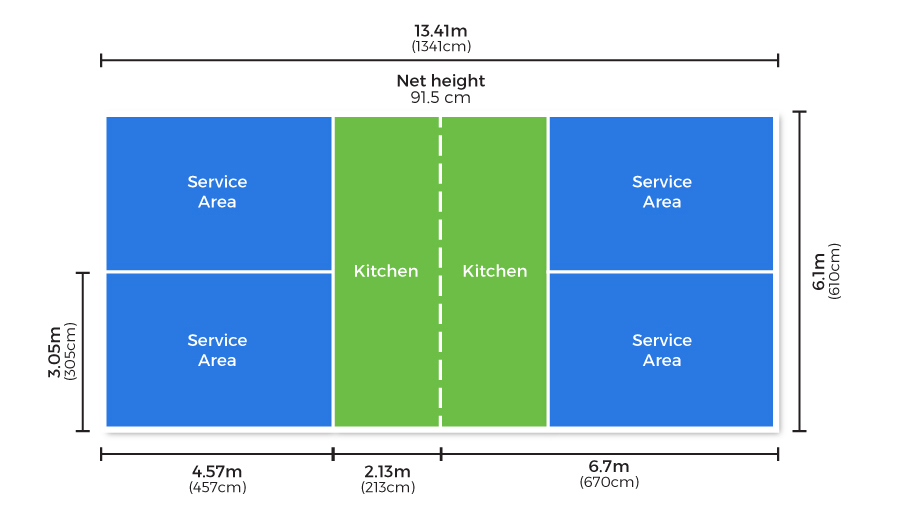
How wide is a pickleball court in meters?
It is about 6.10 meters wide. The length is about 13.41 meters.
Conclusion
The answer you came for is simple: a pickleball court is 20 feet wide. Use that width to plan your layout, add safe buffer space, and keep lines clean and visible. When in doubt, measure twice, check the diagonal, and keep the net at the right height.
Ready to set one up? Grab a tape, mark that 20-foot width, and start playing. Want more help? Subscribe for layout templates, gear checklists, and quick setup guides.