

The pickleball kitchen is 20 feet wide and 7 feet deep.
If you have ever asked how wide is the kitchen in pickleball, you are in the right place. I coach new and seasoned players, and court size questions come up a lot. This guide breaks down kitchen size, rules, and smart play. You will get clear steps, simple tips, and pro checks you can use today.

Kitchen size and what it really means
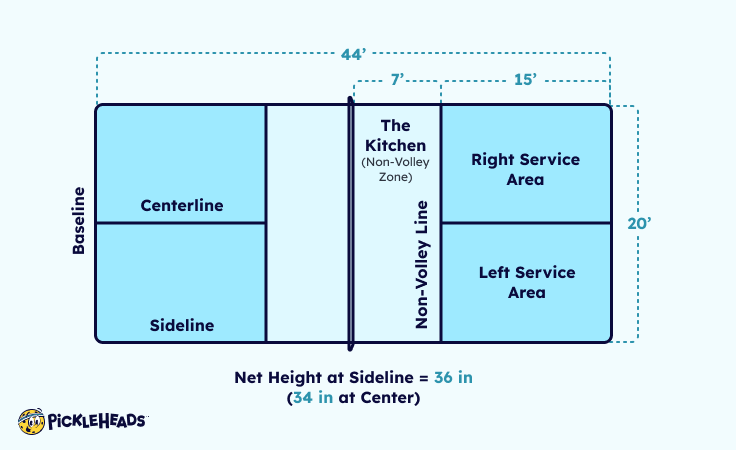
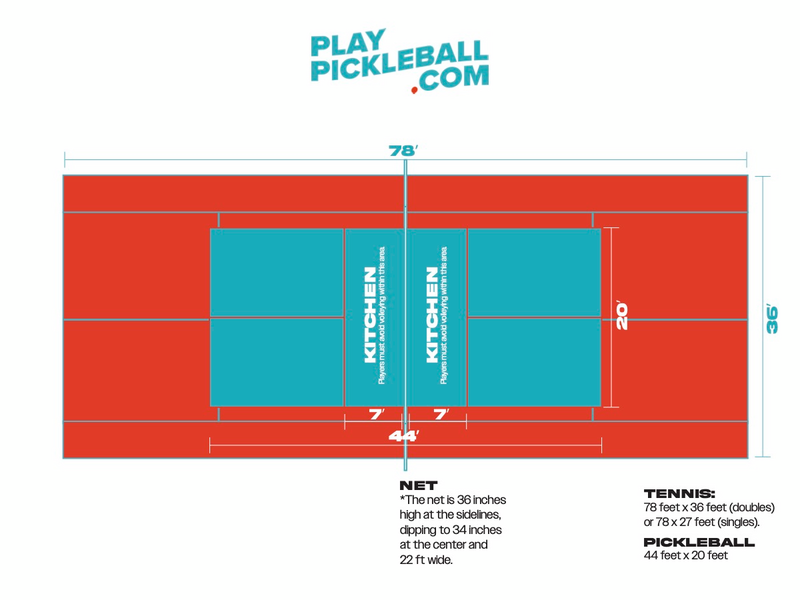
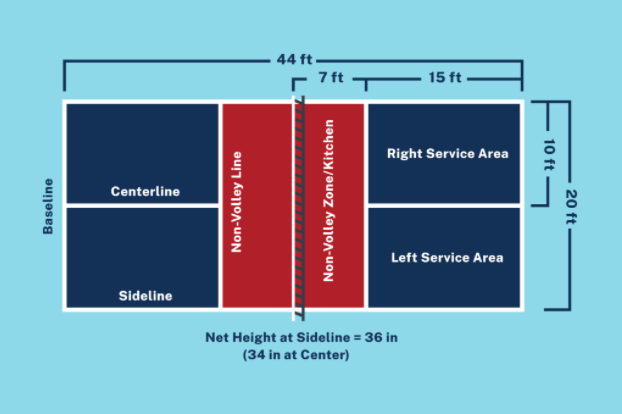
The kitchen is the non-volley zone at the net. It spans the full court width, which is 20 feet from sideline to sideline. It is 7 feet deep on each side of the net. The non-volley zone line is part of the kitchen.
This means your kitchen is a 20-by-7-foot rectangle on each side. If you stand on the line to hit a volley, it is a fault. You may stand in the kitchen only after the ball bounces. The full pickleball court is 20 by 44 feet.
If you came here to confirm how wide is the kitchen in pickleball, the answer is 20 feet across. When you plan drills, tape lines, or train angles, use that number. It sets your targets and your footwork.

Why the kitchen width matters for real play
That 20-foot width shapes every point. Crosscourt dinks must travel far and low. Down-the-line shots must hug the sideline. Your team must cover 10 feet each when you guard the kitchen.
Angles open fast in a 20-foot span. A soft dink to the outer third pulls your rival off balance. Then you attack the gap. Coaches often teach spacing with one rule: shoulders square, paddles up, and feet split on the kitchen line.
Many players google how wide is the kitchen in pickleball to plan doubles spacing. The width guides who takes the middle and who protects the line. Use it to call shots and avoid both partners chasing the same ball.
How to measure and mark the kitchen at home
You can mark a backyard court in under 30 minutes. Use these simple tools and steps.
Tools you need:
- A 25–50 foot tape measure
- Painter’s tape or chalk
- A pencil and string
- A straight edge or yard stick
Steps:
- Mark the net line across 20 feet.
- From the net, measure 7 feet back on both sides. Snap a straight line. That is your kitchen line.
- Extend the sidelines to 22 feet behind the kitchen line to reach the 44-foot court length.
- Confirm the court is 20 feet wide at the kitchen line and the baseline.
- Re-check all right angles with a 3-4-5 triangle or a carpenter square.
Pro tip: Tournament teams measure how wide is the kitchen in pickleball at set-up to avoid disputes. Do two passes with the tape to be sure your lines are square and true.
Common mistakes and myths to avoid
People mix up width and depth. Width is 20 feet. Depth is 7 feet from the net. Saying the kitchen is 14 feet wide is wrong. Fourteen feet is the combined depth of both kitchens, not the width.
Another myth is that a volley is fine if you do not land in the kitchen. That is false. If your momentum takes you into the kitchen after a volley, it is a fault. The line counts as the kitchen too.
Some think the centerline runs through the kitchen. It does not. The centerline starts at the kitchen line and runs to the baseline. When in doubt, check the latest official rulebook and measure again.
Players often ask how wide is the kitchen in pickleball when buying pre-cut tape kits. Check the package. It should match a 20-foot span and a 7-foot depth for the non-volley zone.
Strategy: Use the full 20 feet to your edge
Use width to stretch your rivals. A wide crosscourt dink adds safety over the net and pushes them off court. Then aim at the open middle. Keep the ball low and soft until you can speed it up.
Practical drills:
- Crosscourt dink ladder: Aim for three wide targets, from safe middle to near sideline.
- Corner-to-corner reset: Drop from the transition zone to the outer third of the kitchen.
- Middle callouts: One player yells “mine” on balls at the T to avoid clashes.
Tip from my sessions: Say how wide is the kitchen in pickleball aloud as a cue in practice. It reminds you to use the full 20 feet and not camp in the center. Your angles will improve fast.
Key rules you must know near the kitchen
You can enter the kitchen any time the ball has bounced. You cannot volley while standing on the line or inside the zone. If your paddle, hat, or body touches the kitchen after a volley, it is a fault due to momentum.
Lines matter. The non-volley zone line is part of the kitchen. The net carries over the kitchen but is not part of it. Always wait for the bounce if any part of you is in or on the line.
Coaches and refs repeat this because it prevents errors. Players who ask how wide is the kitchen in pickleball also need this rule. It saves free points and keeps play fair.
Build a simple court checklist
Before you serve, run a fast check. It takes one minute and avoids headaches.
Quick checklist:
- Confirm the court is 20 feet wide, kitchen included.
- Measure 7 feet from the net to the kitchen line on both sides.
- Check lines are clear, not smudged.
- Make sure there is safe space behind baselines.
- Keep extra balls and water off the court.
Event crews check how wide is the kitchen in pickleball during every setup. Do the same at home or at the park. Small prep steps lead to smooth games.

Frequently Asked Questions of how wide is the kitchen in pickleball
Is the kitchen 20 feet wide or 14 feet wide?
It is 20 feet wide across the court, sideline to sideline. Fourteen feet is the combined depth of both kitchens, not the width.
How deep is the kitchen from the net?
The kitchen is 7 feet deep from the net on each side. That line at 7 feet is included in the kitchen.
Can I stand on the kitchen line and volley?
No. The line is part of the kitchen, so standing on it during a volley is a fault. You must be fully out of the kitchen and stable.
Does momentum into the kitchen after a volley count as a fault?
Yes. If any part of you or your gear touches the kitchen after a volley due to momentum, it is a fault. Wait for control before stepping forward.
Why does the kitchen width affect doubles strategy?
Twenty feet is a lot of space to cover, so teams must share lanes. Clear roles help guard the line, protect the middle, and set smart angles.
How wide is the kitchen in pickleball on temporary courts?
It is still 20 feet wide. Always measure and mark to match official specs, even on a driveway or gym floor.
How wide is the kitchen in pickleball for singles vs doubles?
The width does not change. Singles and doubles both use a 20-foot-wide kitchen.
How wide is the kitchen in pickleball at tournaments?
At sanctioned events, the kitchen must be 20 feet wide and 7 feet deep. Staff verify this during court inspection.
Are the kitchen lines the same on all paddle sports?
No. Pickleball uses a 7-foot non-volley zone and 20-foot width. Tennis and badminton have different zones and lines.
How wide is the kitchen in pickleball on portable nets?
The net type does not change kitchen size. The kitchen stays 20 feet wide, measured by the court lines.
Conclusion
The short, true answer is simple: the kitchen is 20 feet wide and 7 feet deep. Know that number, follow the non-volley rules, and shape your shots to use every inch of width. It is a small fix that makes a big lift in your game.
Take one step today. Measure your court, mark clean lines, and run three wide dink drills. Want more tips like this? Subscribe, share this guide with your crew, or drop a question in the comments.