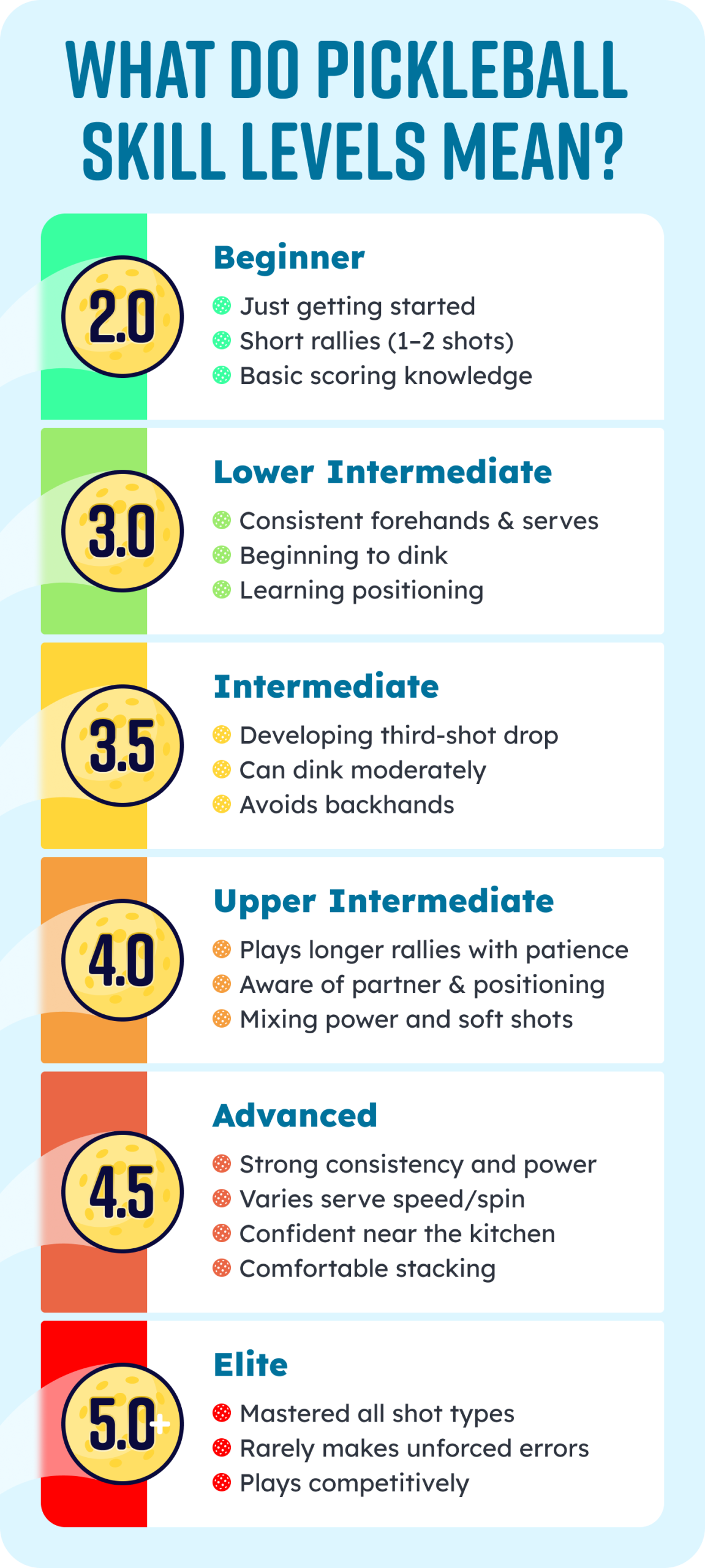
Your pickleball rating is your skill level, measured from beginner to pro.
If you have asked, what is my pickleball rating, you are not alone. I help players find their level every week, and the process is simple when you know the signs. This guide explains ratings in plain language. I will show you how to estimate your number today, get an official score, and build a plan to move up.
How pickleball ratings work
A pickleball rating is a number that reflects your skill. It helps match you with players at your level. It also guides you to drills, leagues, and events that fit your game.
There are two common paths. One is a self-rating you choose. The other is a score based on your results. Most clubs accept both. In tournaments, they use trusted systems.
Three systems are common in the sport. Self-rating is your own estimate from 1.0 to 5.5+. UTPR is the USA Pickleball Tournament rating. DUPR is a global system that updates when you play. Each one helps answer, what is my pickleball rating.
Both UTPR and DUPR rely on who you play and who you beat. They adjust by score and the level of your opponents. Doubles and singles are tracked on their own. This matters if you do much better in one format.

Quick way to estimate your level today
If you need a fast answer to what is my pickleball rating, use this quick test. Be honest and think about your most recent games.
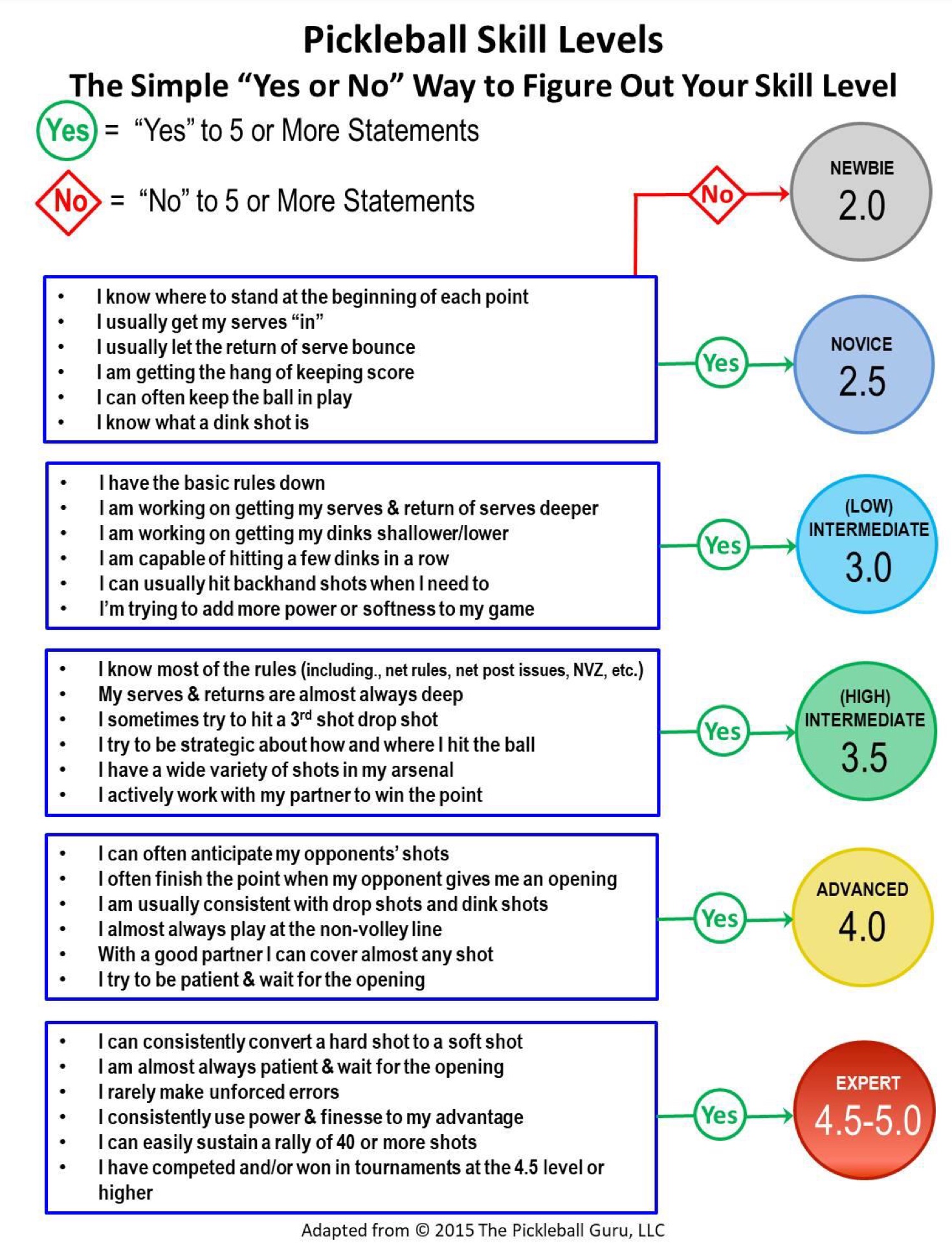
- If you are learning rules, grips, and how to keep score, you may be 1.0–2.0.
- If you can rally and serve in most points, you may be 2.5.
- If you can keep dinks, attack pop-ups, and place serves, you may be 3.0.
- If you can reset from the mid-court and control pace, you may be 3.5.
- If you can speed up on purpose and defend counters, you may be 4.0.
- If you build points with thirds, stacks, and patterns, you may be 4.5.
- If you win often against 4.5s and medal in tough draws, you may be 5.0+.
When I coach league nights, I also check two signs. Can you win points without forced errors? Can you change plan when a team finds your weak spot? These shape your real level.

Skill levels explained: 1.0 to 5.5+
Here is a clean view of each level. Use it to refine your answer to what is my pickleball rating.
- 1.0–2.0 Beginner. You are new. You learn rules, court lines, and basic shots. You try to get the ball in play.
- 2.5 Advanced beginner. You serve and return with some aim. You know the kitchen rule. You can hit a few dinks in a row.
- 3.0 Early intermediate. You place shots. You can keep a soft rally. You try some third shots. Volleys are still rough under pressure.
- 3.5 Solid intermediate. You reset from the transition zone. You mix soft and hard. You see patterns and cover middle better.
- 4.0 Advanced. You drive or drop based on the return. You attack pop-ups on purpose. You defend counters. You stack to protect a side.
- 4.5 High advanced. You use speed-ups at the right time. You hit clean thirds under stress. You bait errors and win with plans, not luck.
- 5.0–5.5+ Expert. You medal in strong events. You win with pace, spin, and shape. You scout rivals and adjust mid-game with ease.
Note this split by format. Your 3.5 doubles level does not always match your singles level. If you ask what is my pickleball rating for singles, test it on its own.

Getting an official rating: DUPR, UTPR, and self-rating
If you want a number others can see, use DUPR. It is free. You log matches, even rec games. It uses the score, who you played, and margin of win. It gives you a number for singles and doubles. Many clubs take it.
UTPR is tied to sanctioned events. You need to play in those to get a number. It is used for seeding and brackets. If you play a lot of tournaments, UTPR will matter more.
Self-rating still helps if you are new. Many sites ask for it when you join. Read the skill list above before you choose. If you wonder what is my pickleball rating and have no match data, start with a self-rating and adjust within a month.
Pro tip from my own play. I synced my DUPR after a local league. Ten logged matches gave a stable number. It matched my feel better than a guess.

How to improve your rating fast
If you want to raise the answer to what is my pickleball rating, use a simple plan. Keep it short and steady so you stick to it.
- Work on one skill per week. Example: third shot drop on week one. Dink depth on week two. Reset from mid-court on week three.
- Play up one half level once a week. You will lose some points. You will learn twice as fast.
- Track two stats per game. Unforced errors and third shot result. Fix the bigger leak first.
- Drill 15 minutes before games. Volleys, dinks, and serves. Use targets. Small gains here show up fast.
- Find a partner who talks. Plan plays. Call middle. Review a key point after each game.
From my own ladder matches, the biggest jump came from better thirds. I set a box target three feet inside the kitchen. I hit 50 drops on each side. In two weeks, my errors fell, and my rating rose.

Common mistakes that stall your rating
If you keep asking what is my pickleball rating and it never moves, check these traps.
- You only play at the same park and level. You need stress to grow.
- You do not track errors. You guess what to fix, and you fix the wrong thing.
- You swing the same on every ball. Learn to slow down and reset bad spots.
- You aim for lines. Pros win with big targets more than edge shots.
- You skip warm-ups. Cold hands make bad thirds and pop-ups.
I once chased spin serves for a month. It was fun, but it did not help my doubles wins. When I went back to resets and dinks, the results came back.

Tools, apps, and resources
Good tools speed up the path to a higher answer for what is my pickleball rating.
- Rating apps. DUPR for match logs and numbers. Many clubs now sync with it.
- Video. Record on your phone from the back fence. Watch two rallies you lost. Look for shot choice, not just stroke form.
- Ball machine or wall. Ten minutes of resets off a wall builds calm hands fast.
- Clinics and lessons. A single small tweak to your ready position can save five points a game.
- Local clubs and ladders. You need steady games at and above your level.
For rules and rating terms, check official bodies. Their guides explain skills by level. Use those lists to test what is my pickleball rating with clear standards.
Frequently Asked Questions of what is my pickleball rating
How do I find my rating if I only play rec games?
Log your scores in a rating app that allows rec results. After 5–10 games, you will see a stable number you can use.
Is DUPR better than UTPR?
They serve different needs. DUPR updates from many matches, while UTPR is for sanctioned events and seeding.
Can my singles and doubles ratings be different?
Yes, and they often are. Movement, stamina, and patterns differ, so track both.
How often should I update my self-rating?
Check it every month or after 10–15 games. Move up or down if your win rate is far from 50%.
What rating should I enter for a league if I am unsure?
Pick the lower of your two guesses. If you win easy, ask to move up next session.
Do clinics help my rating more than play?
Both help, but clinics fix form and choices faster. Mix one clinic with two play days each week.
How long does it take to move from 3.0 to 3.5?
With steady drills and smart play, many do it in 8–12 weeks. Your pace may vary based on reps and partners.
Conclusion
Your rating is a tool, not a label. Use it to find fair games, pick drills, and set clear goals. If you keep asking what is my pickleball rating, log matches, study two key stats, and play one level up once a week.
Start today. Pick one skill to train, book three games, and record your scores. Share your current answer to what is my pickleball rating in the comments, and tell me your next goal.