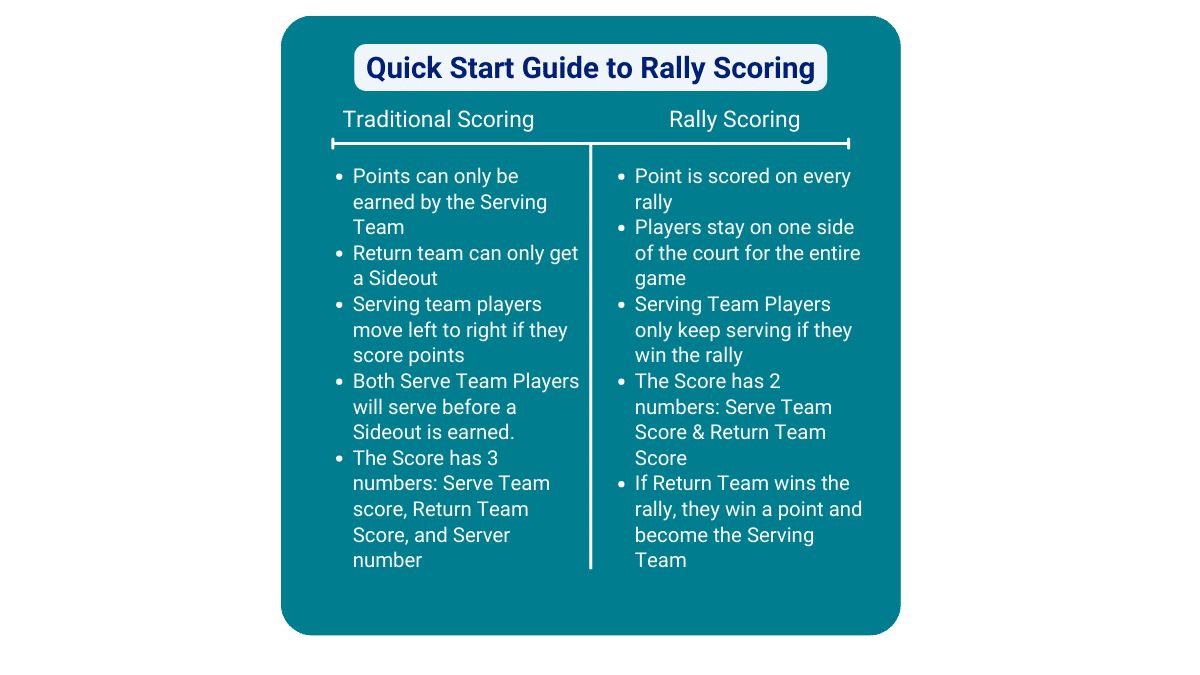
Rally scoring means every rally earns a point, no matter who served.
If you’ve ever wondered what is rally scoring in pickleball and whether it changes how you play, you’re in the right place. I teach and play weekly, and I’ve tested rally scoring in leagues, clinics, and rec nights. Below, I break it down in plain English, show how it compares to side-out scoring, and share real match tips so you can use it with confidence.
What Is Rally Scoring in Pickleball?
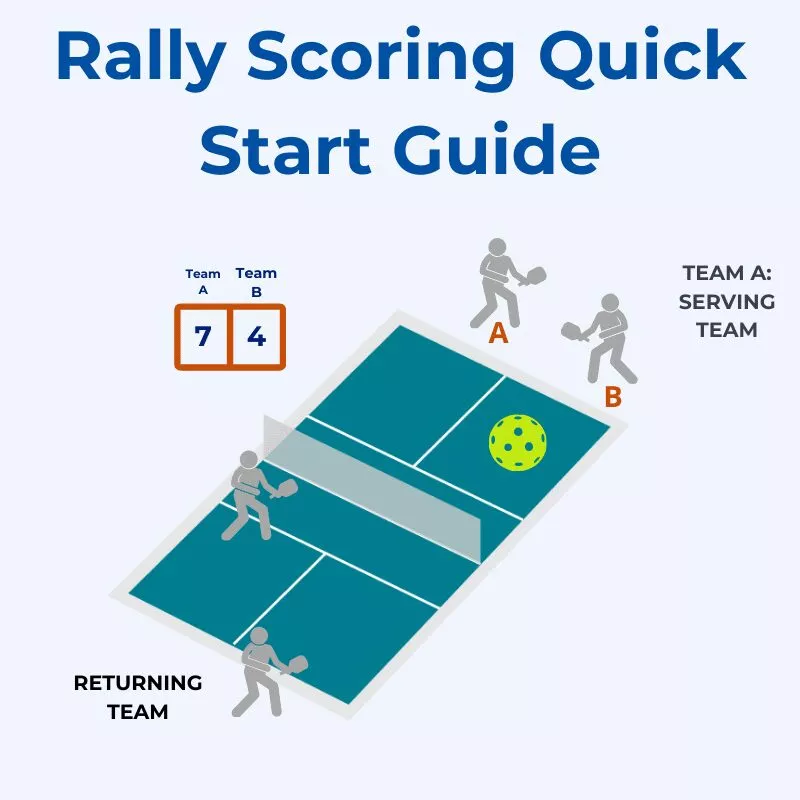
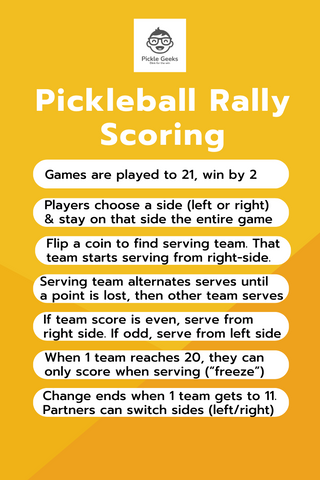
Rally scoring is a scoring system where a point is awarded on every rally, whether you served or received. The core idea is simple: win the rally, earn a point. Then, the serve switches based on the format your group uses.
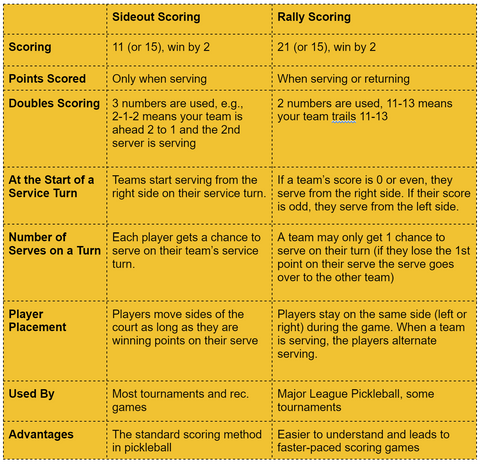
There isn’t one single global standard. Many formats go to 11, 15, or 21 points and still require a 2-point margin. Some leagues add a “freeze” near the end. That means the last point must be won on serve. When people ask what is rally scoring in pickleball, this is the key difference from side-out scoring.
In most club versions, the team that wins a rally gets the point and the next serve. Player positions follow the same rules you already know: even score on the right, odd score on the left. If you’re learning what is rally scoring in pickleball for the first time, expect faster games and more predictable match times.

Rally Scoring vs. Side-Out Scoring
Side-out scoring is the traditional system. Only the serving team can score. You rotate serve within the team, then the serve passes to the other side after a fault. That creates longer games and more momentum swings.
Rally scoring changes the math and the flow:
- Every rally produces a point. No empty rallies.
- Serve often switches after each rally. The winner of the rally serves next, in many formats.
- Game length is more consistent. This helps leagues and broadcasts.
- Pressure shifts to both sides, since you can win or lose points on return.
If you want the quick takeaway for what is rally scoring in pickleball: it rewards every rally and reduces game-time swings that come from long, scoreless return streaks.
How Rally Scoring Works: Rules and Format
Event organizers may choose slightly different settings. Here’s the common setup I use with clubs and clinics:
- Scoring and target
- A point is scored on every rally.
- Play to 11, 15, or 21. Win by 2 unless noted.
- Serve control
- The team that wins the rally serves next.
- Positions follow the score: even on the right, odd on the left.
- Start of game: a coin toss decides serve or side, same as usual.
- Freezes and finals
- Some formats add a freeze near the end. For example, at 20–20, only the serving team can win the final point.
- If your group uses a freeze, clarify it before play.
- Calling the score
- Call your team’s score first, then the opponent’s score.
- Some groups drop server numbers in rally scoring. Keep track of positions instead.
I’ve seen many new players ask what is rally scoring in pickleball because they want faster games. This setup delivers that, while keeping rules clear and fair.

Why Rally Scoring Matters: Pros and Cons
Rally scoring is more than a trend. It changes strategy, match time, and viewer experience. Sport analytics across net games show rally scoring reduces variance in game length. That keeps schedules tight and matches more TV-friendly.
Pros:
- Predictable timing. Points add up on every rally.
- Constant engagement. Both serve and return feel important.
- Easier for new players to follow. The score moves every rally.
Cons:
- Less room for long comebacks, depending on target score and freeze rules.
- Mistakes on return are costly. You give away both a point and the next serve.
- If you love grinding side-outs, you’ll miss that style of pressure.
For anyone weighing what is rally scoring in pickleball against side-out scoring, think about your goals. Do you need tight timing and faster results? Rally scoring fits that need well.
Strategy Shifts Under Rally Scoring
When every rally counts, little habits add up. Here’s what has worked for me and my students:
- Prioritize high-percentage returns. Deep, safe returns reduce drive speed and set up your transition.
- Mix third shots with intent. Drive early to test hands; drop when you need time to reach the kitchen.
- Shift serve philosophy. Aim for 80–90% first-serve depth. One extra miss grants a free point.
- Protect the middle. Doubles points arrive fast when you lose shape. Call the switch early.
- Use timeouts and resets. Break momentum sooner. One lost rally is one point.
If a teammate asks what is rally scoring in pickleball and how to adjust, tell them: don’t give free points. Serve deep, return deep, and value first-ball contact.
Common Mistakes and How to Avoid Them
I see these errors when groups first try rally scoring:
- Playing like it’s side-out. Solution: tighten serve and return margins. Value first-ball accuracy.
- Ignoring the freeze. Solution: agree on freeze rules before game one. End-game confusion ruins flow.
- Forgetting positions. Solution: tie your spot to the score. Even score, right side; odd score, left side.
- Over-hitting on return. Solution: use height, depth, and spin, not hero shots.
- Rushing between points. Solution: take a breath. Rally scoring moves fast. Control your tempo.
Share this list when someone asks what is rally scoring in pickleball and why it feels different. It keeps the session smooth.

Real-World Example: Scoring Walkthrough
Let’s run a short example to 11, win by 2, no freeze:
- Rally 1: Team A wins the rally while receiving. Score 1–0 A. Team A now serves.
- Rally 2: Team A wins again. Score 2–0 A. Team A keeps serve.
- Rally 3: Team B wins on the return. Score 2–1 A. Serve goes to Team B.
- Rally 4: Team B wins the serve rally. Score 2–2. Team B keeps serve.
- Rally 5: Team A wins on the return. Score 3–2 A. Serve moves to Team A.
Keep that pattern until 11, win by 2. If your group asks what is rally scoring in pickleball and how it flows, walk through a few rallies like this. It clicks fast.

Is Rally Scoring Official in Pickleball?
Most sanctioned tournaments still use side-out scoring under current rulebooks. Rally scoring is common in some leagues, team events, and club play. Organizers choose the exact rules, target score, and whether to use a freeze.
When people ask what is rally scoring in pickleball in an official sense, the answer is: it’s recognized, tested, and popular in certain formats, but side-out remains the standard in most sanctioned brackets. Always check the event sheet before you play.

Frequently Asked Questions of what is rally scoring in pickleball
Does rally scoring change how I call the score?
You still call your score first and your opponent’s score second. Many groups drop server numbers in rally scoring and rely on right-side for even, left-side for odd.
Can I win a game while receiving in rally scoring?
In pure rally scoring, yes. If a freeze is used, the final point must be won on serve, so you cannot close the game on return during the freeze.
What target score works best for clubs?
Play to 11 for quick rotations, 15 for league blocks, and 21 for match-play depth. Choose based on court demand and time.
Is rally scoring better for beginners?
Often yes, because the score moves every rally and games end faster. It also teaches return discipline early, which is a key skill.
Do kitchen and foot-fault rules change?
No. All standard rules about the non-volley zone, double bounce, and faults still apply. Rally scoring only changes how points are awarded.
Do I still switch sides at 6 or 8 points?
Follow your event format. Many groups switch ends at the halfway mark of the target score to balance sun and wind.
Does rally scoring favor aggressive players?
It rewards smart aggression and first-ball control. You should attack when set, but value safe depth on serves and returns.
Conclusion
Rally scoring makes every rally matter. It speeds up play, balances serve and return pressure, and gives leagues cleaner schedules. If you came here asking what is rally scoring in pickleball, now you know how it works, why it’s used, and how to win with it.
Try it in your next club night. Agree on target score and freeze rules. Track positions, breathe between points, and value first-ball contact. Want more guides like this? Subscribe for updates, share this with your partner, and drop your questions in the comments.