
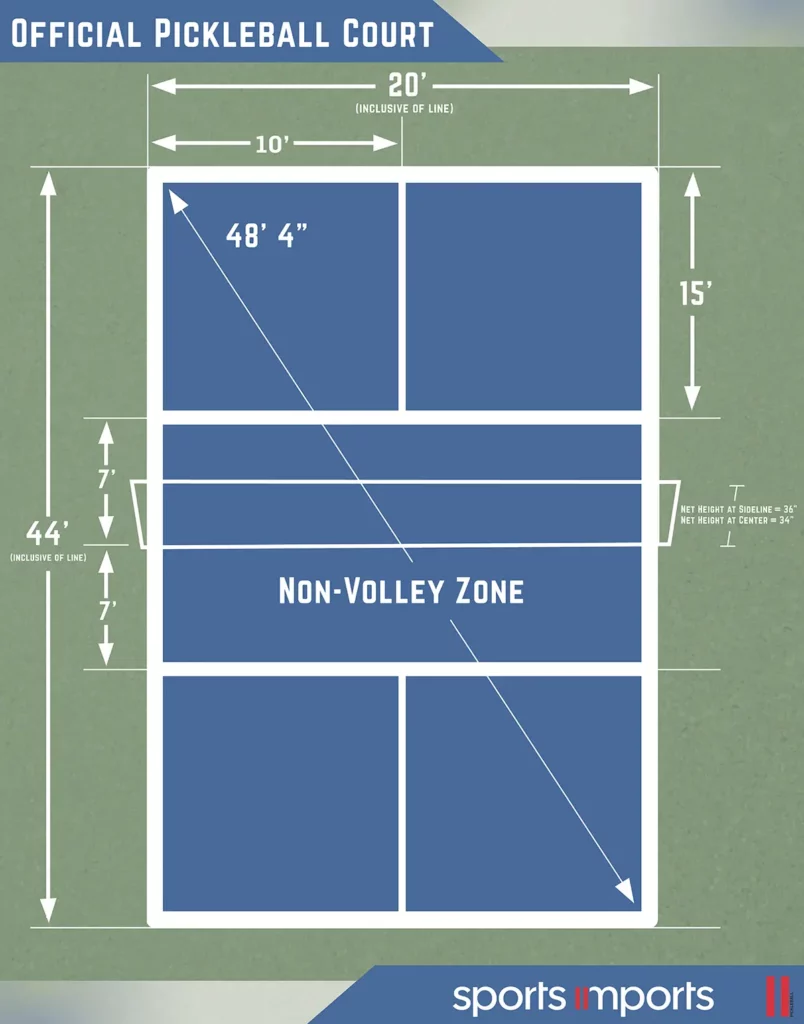
A pickleball court is 20 by 44 feet with 7-foot kitchens, 34-inch center net.
You came here to learn what's the dimensions of a pickleball court, and I’ve got you covered. I’ve laid out the official sizes, why they matter, and how to mark a court the right way. Stick with me for clear diagrams in words, pro tips from real installs, and simple steps to get it right the first time.
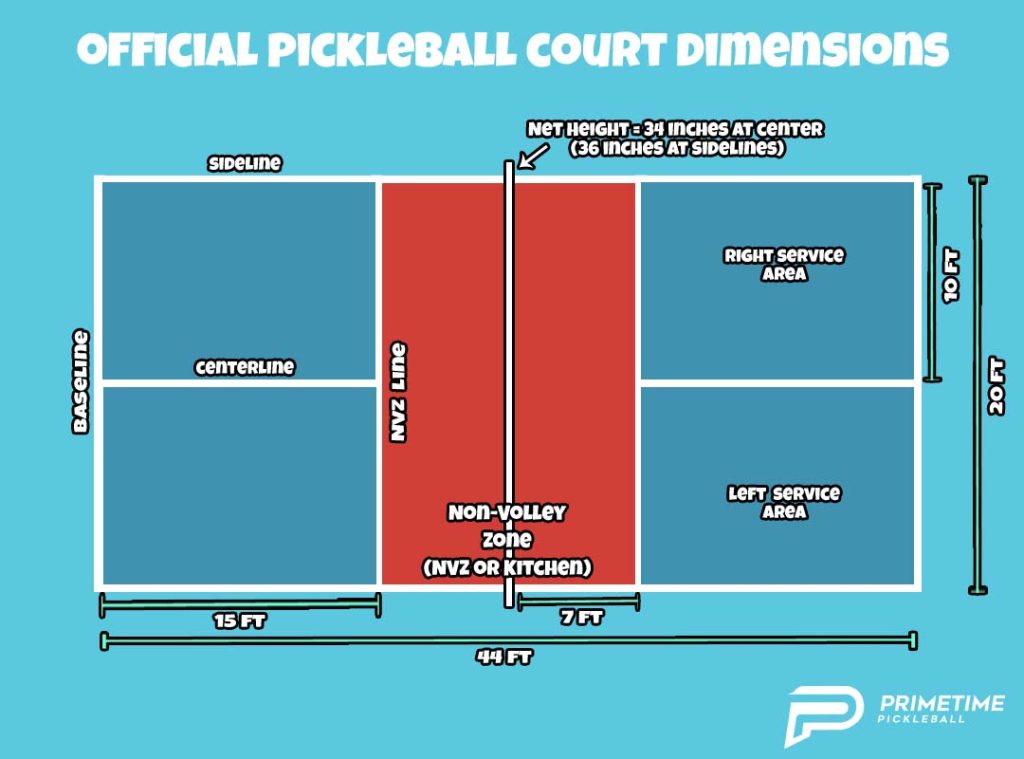
Standard pickleball court dimensions
If you’re wondering what's the dimensions of a pickleball court, the official playing area is 20 feet wide by 44 feet long (6.10 m × 13.41 m). This size is the same for singles and doubles. From the net to the baseline is 22 feet on each side. The non-volley zone, or kitchen, is 7 feet deep from the net on each side.
The net stands 36 inches high at the sidelines and 34 inches at the center. Court lines are 2 inches wide and count as in. The non-volley line is part of the kitchen, which affects serves.
For safe play, plan extra space around the court. The minimum total area is 30 by 60 feet. The preferred area is 34 by 64 feet. This buffer helps you chase lobs, avoid walls, and keep play smooth.
When people ask what's the dimensions of a pickleball court in meters, the key numbers are 6.10 m by 13.41 m for the court. The kitchen is 2.13 m. The preferred total area is about 10.36 m by 19.51 m.
I’ve painted many courts for clubs and schools. Each time, we start with this framework. If you lock these sizes in, lines, nets, and gameplay all fall into place.
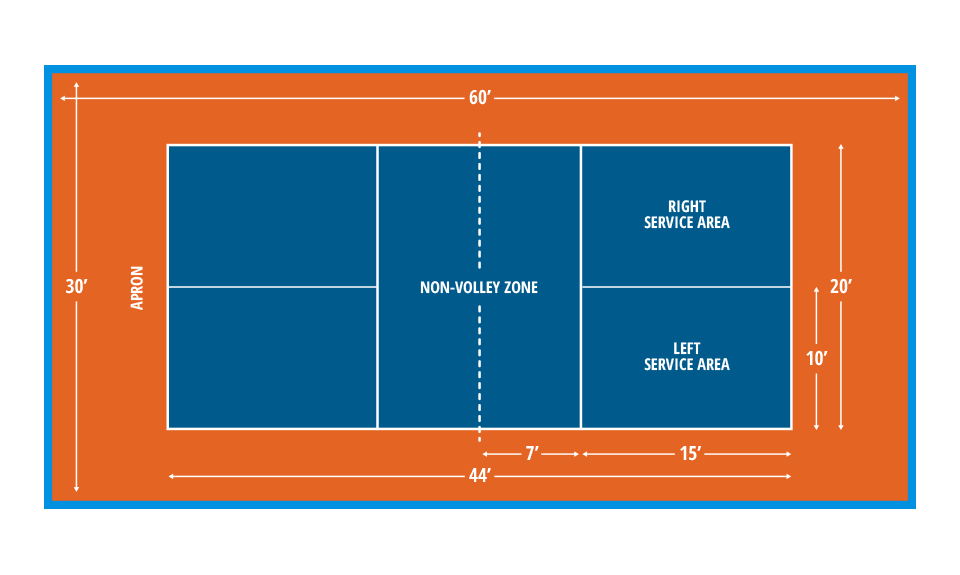
Layout breakdown: zones and lines
Understanding the layout helps you mark lines fast and play by the rules. It also clarifies what's the dimensions of a pickleball court in each section.
Baselines and sidelines
The baseline is the 20-foot line at the back. The sidelines run the 44-foot length. All lines are 2 inches wide.
Kitchen (non-volley zone)
The kitchen starts at the net and extends 7 feet on both sides. You cannot volley while you or anything you wear touches this zone. The non-volley line is part of the kitchen.
Service courts
Each side has two service boxes. They are split by the centerline. Each service court is 10 feet wide by 15 feet deep.
Centerline and service rules
The centerline runs from the kitchen line to the baseline. On the serve, the ball must land past the kitchen line in the diagonal service box. Hitting the non-volley line on the serve is short.
Net and posts
The net spans about 22 feet from post to post. Posts sit about 1 foot outside each sideline. Measure 36 inches high at the posts and 34 inches at the center. A center strap helps set the dip.
Line color and contrast
Use a high-contrast color that is easy on the eyes. On tennis overlays, pick a shade that stands out without confusing lines.
Knowing these parts makes it easier to explain what's the dimensions of a pickleball court to new players, and it reduces setup mistakes.

Indoor vs outdoor courts and surfaces
Indoor and outdoor courts use the same 20 by 44-foot grid. But surface and space change play.
Indoor
- Consistent bounce on hardwood or sport tile.
- No wind or sun. Quieter visuals and tighter run-off.
- Watch for glare. Aim for even light and at least 18–20 feet of ceiling clearance.
Outdoor
- Asphalt or post-tension concrete with acrylic coatings is common.
- Wind, sun, and temperature affect play. Orient courts north–south to reduce sun issues.
- Use wind screens and fences for safety and ball control.
If you need to answer friends asking what's the dimensions of a pickleball court for indoor vs outdoor, remind them the footprint is the same. Only the environment changes.
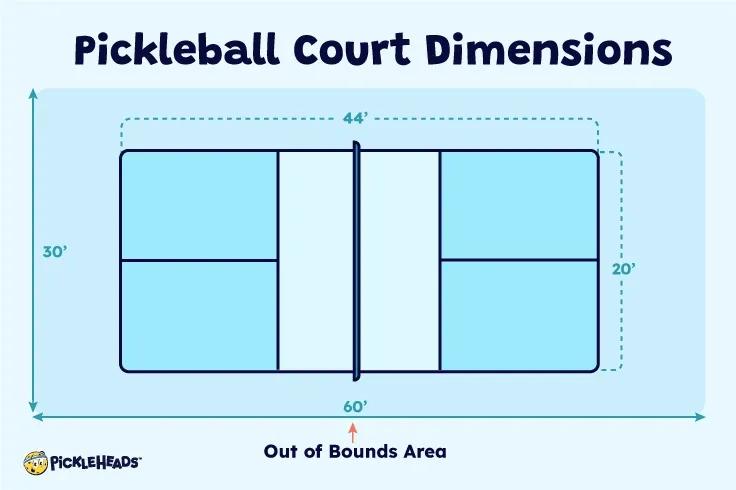
Space planning and clearances
A good court is more than lines. Plan the space around the lines to protect players.
Recommended areas
- Minimum total area: 30 by 60 feet.
- Preferred total area: 34 by 64 feet for events and safe run-off.
- Multi-court spacing: At least 10 feet aisle space between courts if possible.
Smart layout tips
- Orient courts north–south when outdoors.
- Keep hard walls and fences outside the preferred area.
- Use padding on nearby poles, fences, or posts.
- Plan ADA routes with smooth surfaces and clear paths.
When clients ask what's the dimensions of a pickleball court for a backyard, I recommend starting at 30 by 60 feet. If space is tight, protect the backstops and corners with padding.

How to mark and build a court (DIY)
Here is a simple, field-tested method I use to stripe courts. It keeps angles square and measurements true.
Tools
- Two 100-foot tape measures
- Chalk line and pencil
- Masking tape or painter’s tape
- Straightedge and measuring wheel
- Portable net system
Steps
- Snap a baseline. Mark a straight 20-foot line. Use a 3-4-5 triangle to square the first sideline.
- Measure the length. From each baseline corner, run 44 feet to set the far baseline. Snap the second baseline.
- Check diagonals. Measure corner to corner. Adjust until both diagonals match. Now your rectangle is true.
- Mark the net and kitchens. Find the midline between baselines. Snap the net line. Mark 7 feet on both sides for the non-volley lines.
- Add service lines. From each non-volley line, measure 15 feet to the baseline to define service courts. Snap the centerlines.
- Tape and paint lines. Keep lines 2 inches wide. Pull tape tight. Remove tape while paint is tacky for clean edges.
- Set the net. Posts sit about 22 feet apart. Tune the net to 36 inches at the posts and 34 inches at center.
A common question is what's the dimensions of a pickleball court when overlaying on tennis. Use the same 20 by 44 feet, centered within one half of a tennis court. I keep a printed template on hand to speed this up.

Common mistakes and pro tips
I’ve seen the same few errors across parks, gyms, and driveways. Here’s how to avoid them.
Mistakes to avoid
- Short kitchens. People mark 6 feet by accident. Always confirm 7 feet from the net.
- Crooked rectangles. If diagonals don’t match, your court is skewed. Re-square before painting.
- Wrong net height. Courts often sit at 36 inches across. You must drop to 34 inches at center.
- Thin lines. Lines that are less than 2 inches change calls and depth cues.
- Tight sidelines. Without at least 30 by 60 feet total area, safety suffers.
Pro tips from installs
- Use two tapes to mark diagonals with one helper. It saves time and fixes squaring fast.
- Pick a matte line color. It reduces glare indoors.
- Test a ball bounce on several spots. Low spots can cause dead bounce and bad calls.
- Keep a portable center strap. It makes the 34-inch center set-and-forget.
Folks often ask me what's the dimensions of a pickleball court for tournaments. I remind them the playing box is fixed, but run-off and spacing make tournament play feel roomy and safe.

Equipment sizing and accessories
A few items complete the court and keep play consistent.
Nets and posts
- Net span is about 22 feet from post to post.
- Height is 36 inches at posts, 34 inches at center.
- Portable nets often include a center strap for the dip.
Lines and markers
- Use 2-inch-wide paint or tape.
- For temporary lines, try removable court tape or chalk on asphalt.
Fences and windscreens
- Set fences beyond the preferred 34 by 64 feet when possible.
- Windscreens tame gusts and give a solid visual background outdoors.
If a buyer asks what's the dimensions of a pickleball court to match a net kit, ensure the net can reach 22 feet and hit the 34-inch center. That check saves returns and fit issues.

Court conversions: tennis or badminton overlays
You can drop a regulation court over a tennis or badminton surface with a few smart tweaks.
On a tennis court
- Use one half of a tennis court. Center your 20 by 44-foot rectangle on the singles sideline and service line area.
- Paint pickleball lines in a contrasting, thinner color to avoid confusion.
- Portable nets help avoid drilling new posts.
On a badminton court
- Badminton doubles are 20 feet wide, which aligns well.
- Length differs, so snap a new 44-foot length and mark kitchens at 7 feet from the net.
- Check the net height. Badminton net height does not match pickleball.
People ask what's the dimensions of a pickleball court when repurposing an old space. The same 20 by 44 feet applies. The trick is aligning lines and setting true net height.

Frequently Asked Questions of what's the dimensions of a pickleball court
What's the dimensions of a pickleball court in feet?
It is 20 feet wide by 44 feet long. The kitchen extends 7 feet from the net on both sides.
What's the dimensions of a pickleball court in meters?
It is 6.10 meters by 13.41 meters. The non-volley zone is 2.13 meters deep from the net.
What's the dimensions of a pickleball court for singles vs doubles?
The court size is the same for both. Only player count and strategy change.
What's the dimensions of a pickleball court including safety space?
The minimum area is 30 by 60 feet. The preferred area is 34 by 64 feet.
What's the dimensions of a pickleball court net height?
The net is 36 inches at the sidelines and 34 inches at the center. Use a center strap to set it right.
What's the dimensions of a pickleball court service boxes?
Each service court is 10 feet wide by 15 feet deep. They sit beyond the 7-foot kitchen line.
What's the dimensions of a pickleball court lines?
All lines are 2 inches wide and count as in. The non-volley line is part of the kitchen.
Conclusion
Now you know what's the dimensions of a pickleball court, how each zone works, and how to build one that plays true. The magic numbers are 20 by 44 feet, 7-foot kitchens, and a net at 36 and 34 inches.
Ready to put this to use? Grab a tape, mark the kitchen, square your lines, and set the net. Share this guide with your crew, subscribe for more build tips, and drop your questions so we can help you get on court fast.