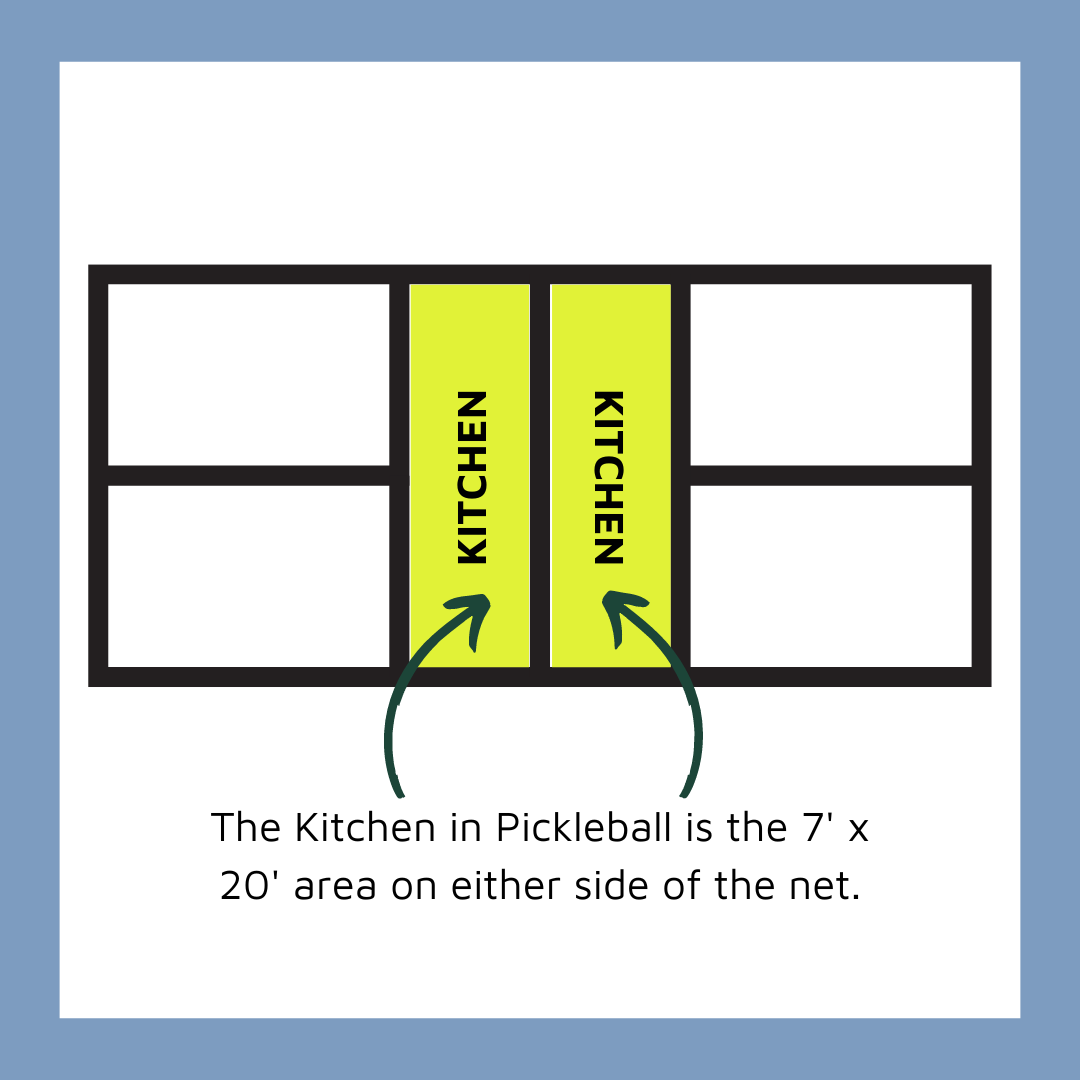
The kitchen is the 7-foot non-volley zone on both sides of the net.
If you have ever wondered where is the kitchen in pickleball, you are not alone. I coach new players every week, and this is the first thing they ask. In this guide, I will break down where the kitchen sits, why it exists, and how to use it to your advantage. You will learn clear rules, simple tips, and smart drills you can use today.

What and where is the kitchen on a pickleball court?
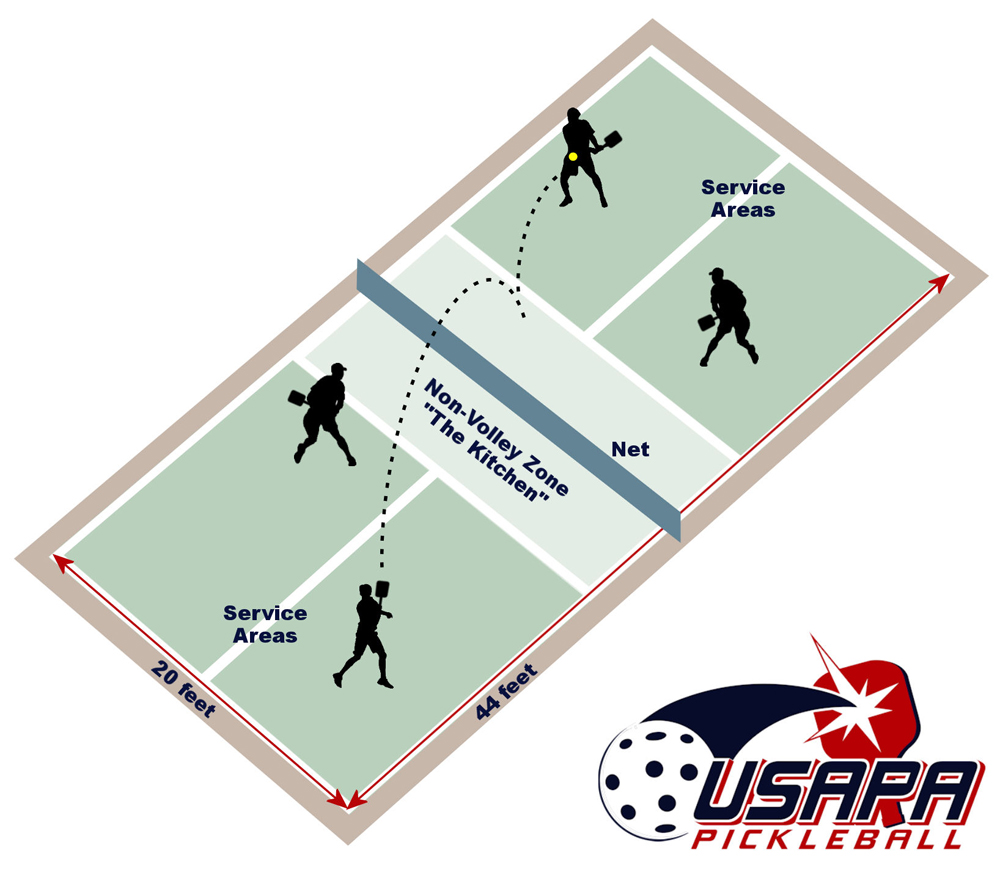
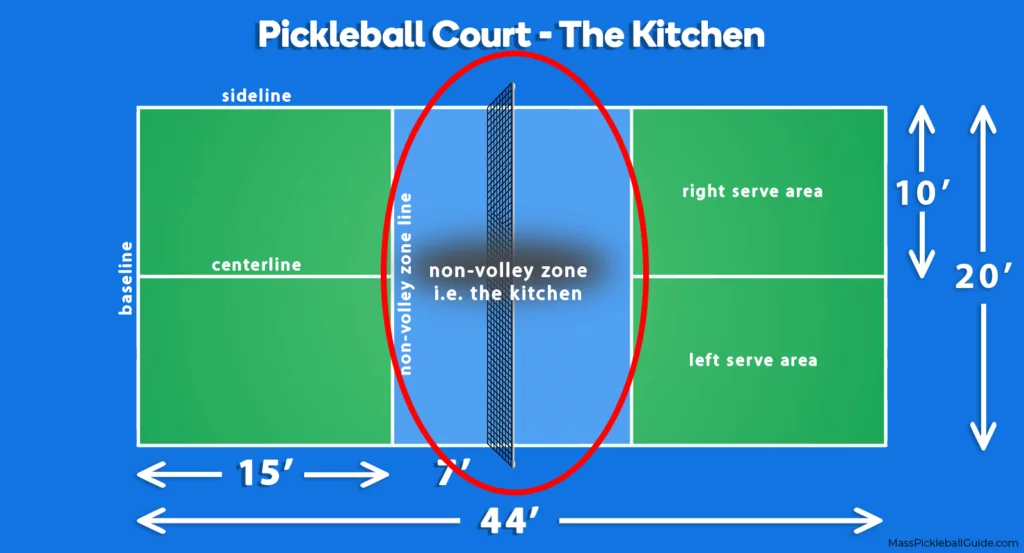
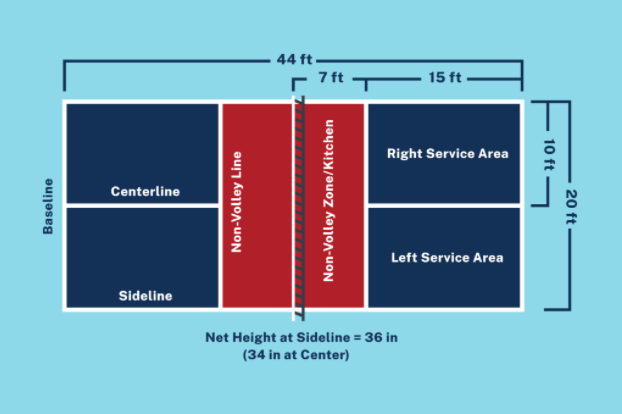
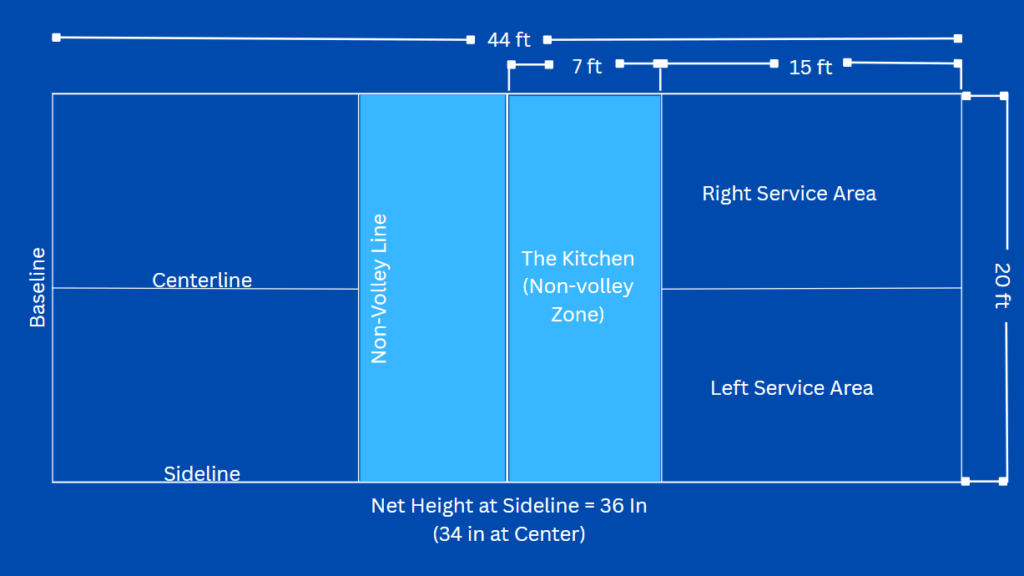
The kitchen is the non-volley zone. It extends 7 feet from the net on both sides of the court. The back edge of the kitchen is the non-volley line. The sidelines and centerline form its left and right edges.
If you ask where is the kitchen in pickleball during play, look for the bold line 7 feet from the net. That line and everything up to the net is the kitchen, including the lines. You cannot volley while touching any part of it.
A quick court map helps. From the net to 7 feet is the kitchen. From 7 to 15 feet is the service box. The whole court is 20 feet wide, so the kitchen is 20 feet wide too.
Why the kitchen exists: safety and better rallies
The kitchen prevents players from smashing every ball right at the net. This keeps games fair and fun. It turns points into chess, not just power.
In my first tournament, I learned this the hard way. I rushed the net and kept faulting on the line. When I respected the kitchen, I got longer rallies and easy put-aways off bad dinks. If you know where is the kitchen in pickleball, you can plan smarter shots and avoid free points for your rivals.

Kitchen rules you must know
These are the rules that matter on most courts. They follow the official standards used across the sport.
- You cannot volley in the kitchen. If you hit the ball in the air while your body or paddle touches the kitchen or the line, it is a fault.
- Momentum counts. If you volley and your momentum carries you into the kitchen, it is still a fault, even if the ball is dead.
- Lines are part of the kitchen. The non-volley line is inside the kitchen. A toe on the line while volleying is a fault.
- You can enter the kitchen after a bounce. If the ball bounces in the kitchen, you can step in and hit it. Then step out to reset.
- Paddles and gear count. Anything you wear or hold that touches the kitchen during a volley is a fault.
Many calls come down to where is the kitchen in pickleball in close points. If you are unsure, ask for a replay or a quick check before tempers rise.
Common myths and mistakes to avoid
New players often mix up the rules. Here are myths I hear a lot on courts.
- Myth: You cannot ever step in the kitchen. Truth: You can step in after a bounce. You just cannot volley there.
- Myth: If only your paddle crosses the line, it is fine. Truth: Any part of your body or gear that touches the kitchen during a volley is a fault.
- Myth: The line is safe. Truth: The non-volley line is kitchen. A toe on it during a volley is a fault.
- Mistake: Leaning to volley while falling in. Tip: Keep your weight back. Hit, then recover. Do not ride your momentum into the zone.
When you know where is the kitchen in pickleball, these errors fade fast. Your footwork gets cleaner, and your confidence grows.
Strategy: how to win at the kitchen
The kitchen is not a no-go area. It is a control zone. Use it to build points.
- Play soft dinks that land near the net. Aim cross-court for margin and angles.
- Attack pop-ups. If a dink floats high, finish with a fast but safe roll shot at the body.
- Keep your paddle up. Stay at eye level with your paddle. This cuts your reaction time.
- Work as a team. In doubles, move like a zipper. Slide together to close angles and cover the middle.
- Ask yourself mid-rally: where is the kitchen in pickleball for my side and theirs? Use that space to set traps.
I teach a three-ball pattern: dink deep cross-court, dink shorter to pull wide, then attack the middle. It wins at all levels.
Drills to master the kitchen
You can improve fast with simple reps. These drills need only one partner.
- Line taps: Stand behind the non-volley line. Tap it with your toe between shots to build line awareness. Volley only when your foot is off the line.
- Box dinks: Place two cones two feet inside the kitchen near the net. Dink into the box. Focus on height and soft hands.
- Push and recover: Step into the kitchen after a bounce, hit a dink, then step back behind the line. Train a clean in-and-out rhythm.
- Speed-up to reset: One player speeds up from the kitchen. The other blocks down into the kitchen, then both reset to dinks.
- Shadow splits: Without a ball, practice split-stepping as your partner pumps their shoulders. This trains balance at the line.
During drills, keep asking where is the kitchen in pickleball relative to your stance. That question locks in clean footwork.

Visualizing the court: a simple map in words
Picture this from the net to the baseline on one side:
- Net to 7 feet: kitchen, full width of 20 feet.
- The non-volley line: the back edge of the kitchen.
- 7 to 15 feet: service boxes, split by the centerline.
- 15 to 22 feet: no-play area during serve. The baseline marks the end.
If a friend asks where is the kitchen in pickleball, point to the space from the net to that bold 7-foot line. Then show how it spans the full width.
Gear and footwork that help at the kitchen
The right shoes and paddle can save points at the line.
- Court shoes with good grip stop line slides. Running shoes can skid on dusty courts.
- A paddle with a soft face helps you dink low and absorb pace at the kitchen.
- Use a light split step before each opponent contact. You will feel springy and set.
- Keep a short, compact swing near the net. Big swings cause pop-ups.
I once changed to a softer paddle after spraying dinks. My control near the kitchen jumped in one week. Small changes make big gains when you know where is the kitchen in pickleball and how to play it.

Frequently Asked Questions of where is the kitchen in pickleball
Where is the kitchen in pickleball?
It is the 7-foot non-volley zone on both sides of the net. The lines are part of the kitchen.
Is the non-volley line part of the kitchen?
Yes. If you touch the line while volleying, it is a fault. Step fully behind it before you hit in the air.
Can I step into the kitchen after the ball bounces?
Yes, you can. Hit the ball after it bounces, then step out to reset and avoid the next volley fault.
Does momentum into the kitchen count as a fault?
Yes. If you volley and your momentum carries you into the kitchen, it is a fault even after the ball dies.
Where is the kitchen in pickleball during singles?
It is in the same place as doubles. Seven feet from the net on both sides, full width of the court.
Can my paddle cross over the kitchen if my feet stay behind?
Your paddle can cross the air space. But if your body or gear touches the kitchen during that volley, it is a fault.
How do I see the kitchen lines better on worn courts?
Ask for a quick chalk refresh before play. If lines are unclear, agree on calls with your opponents before you start.
Conclusion
Now you can point to the spot with confidence when someone asks where is the kitchen in pickleball. It is the space that shapes rallies, rewards control, and makes this game so addictive. Use the rules, drills, and tips here to win the line, not just reach it.
Take one drill today and run 10 minutes of focused reps. Your next match will feel easier. Want more guides like this? Subscribe for weekly tips, or drop a question in the comments so I can help you dial in your kitchen game.