Most outdoor pickleballs have 40 small holes, per common designs and USAP standards.
If you have asked how many holes in an outdoor pickleball, you already care about control, flight, and feel. I coach new and league players, and I’ve tested many balls in heat, cold, and wind. In this guide, I’ll break down how many holes in an outdoor pickleball, why it matters, how it affects your game, and how to choose the right ball with confidence.

Official specs: what the rules say about outdoor pickleballs
The short answer to how many holes in an outdoor pickleball is 40 for most approved outdoor models. Governing bodies set clear specs so balls play fair and safe. The common rule is a ball must have circular holes and fit within approved size, weight, bounce, and hardness limits.
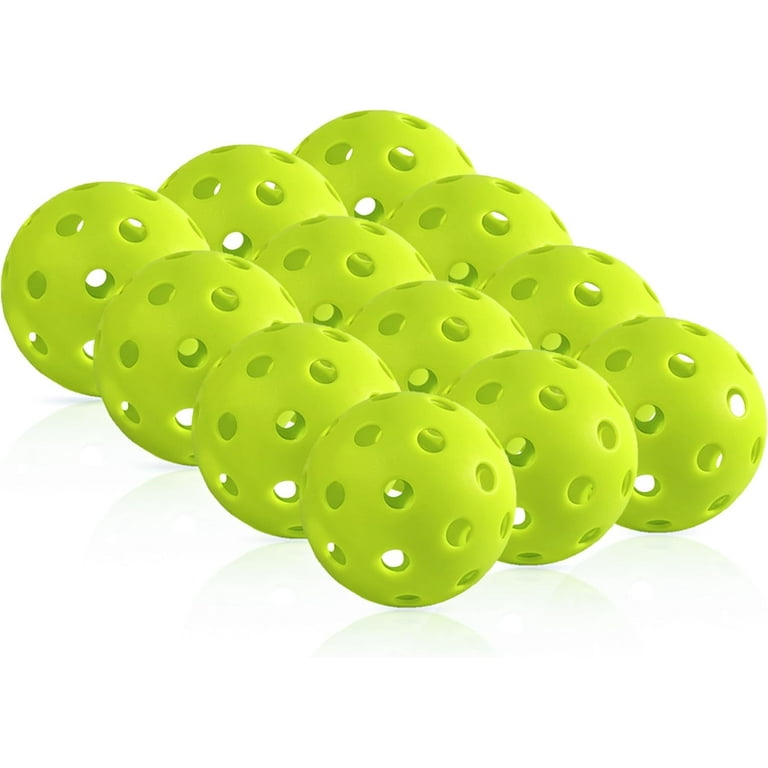
Here is the key point. The official standards allow a range of hole counts. But the outdoor game has settled on 40 holes with small, tight spacing. This shape handles wind and keeps the ball stable at higher speed. Indoor balls often use 26 larger holes. That is why players ask how many holes in an outdoor pickleball when they switch from gym play to parks.
Quality checks also cover roundness, size, and seam strength. A ball must pass flight, bounce, and hardness tests at normal court temperatures. When a ball meets those marks, it earns approval for open play and many events.

Why hole count matters for outdoor play
Hole count changes how air moves through the ball. That changes how the ball flies. If you wonder how many holes in an outdoor pickleball give the best mix of speed and control, the 40-hole build is the sweet spot.
Forty small holes make the ball cut through wind. The ball stays on line when you drive or roll a third-shot drop. With fewer, larger holes, the wind can grab the ball and push it off course. That is why outdoor balls lean on a 40-hole design.
You also feel the difference at the paddle. More, smaller holes mean a firmer shell. The feel is crisp, and the bounce is lively. That helps at the kitchen when you block or reset hard shots.

Outdoor vs indoor balls: hole size, count, and feel
Here is the simple split:
- Outdoor balls: Usually 40 small holes, harder plastic, faster pace.
- Indoor balls: Usually 26 larger holes, softer plastic, softer pop.
This is why players search how many holes in an outdoor pickleball after a first windy day. The indoor 26-hole ball can balloon in gusts. The 40-hole outdoor ball resists that drift.
A few brands tweak hole patterns. But the theme holds. Outdoor equals many small holes. Indoor equals fewer big holes. Your hands will notice the change right away in pace and noise.

Not all 40-hole balls feel the same
You might ask, if the answer to how many holes in an outdoor pickleball is 40, why do balls still feel different? The reason is the details under the hood.
- Hole pattern: Some layouts spread holes evenly. Others cluster near seams. Balance affects flight and spin.
- Plastic blend: A stiffer resin hits faster and louder. A slightly softer blend may grab the court and your paddle better.
- Seam design: Two-piece balls have a seam. Seam height and bonding affect durability and roundness.
I have used 40-hole balls that felt hot and skidded on warm courts. I have used others that grabbed well for topspin and sliced dinks. So while how many holes in an outdoor pickleball is a key factor, the pattern and material also set the tone.
How many holes in an outdoor pickleball affects spin, speed, and control
Let’s turn the knob on aerodynamics in simple terms. Air flows through the holes and around the shell. With 40 small holes, airflow is more uniform. That cuts wobble and keeps the nose of the ball stable.
Here is how that shows up on court:
- Spin: A stable ball holds its axis better. Topspin drives dip later and bite the line.
- Speed: Firmer shells with 40 holes often fly faster off the face.
- Control: Less wobble means cleaner aims on lobs, drops, and blocks.
If you care about a smooth arc, how many holes in an outdoor pickleball is not trivia. It is the backbone of how the ball flies in real wind.

Choosing the right outdoor ball for your level, league, and climate
You do not need a lab to pick a ball. Use this simple filter.
- Windy parks: Use a 40-hole outdoor ball with small, tight holes. It will hold a line.
- Hot weather: Try a ball known for durability in heat. Balls can soften in hot sun.
- Cold weather: Plastic gets brittle. Warm balls before play and expect faster cracks.
- League rules: Many leagues name a preferred 40-hole brand. Match it for practice.
- Skill level: New players can start with any approved 40-hole ball. Focus on feel and control first.
I tell new players who ask how many holes in an outdoor pickleball to start with any common 40-hole option. After a week, they feel the differences. Then they can fine-tune for their game.
Real-world testing notes from the court
I run weekly open play at a windy coastal park. Early on, we tried 26-hole balls by mistake. The wind turned drop shots into floaters. Drives sailed long. We switched to a 40-hole outdoor ball, and play settled in at once.
On calm mornings, I test how many holes in an outdoor pickleball matter by swapping balls mid-game. The 40-hole ball stays true on lobs. It also blocks cleaner at the kitchen. My lesson is simple. If your court has any breeze, the 40-hole design earns its place.

Care, storage, and how to make balls last longer
Even the best 40-hole ball will not last forever. You can stretch its life with a few easy habits.
- Store at room temperature. Extreme heat or cold weakens plastic.
- Rotate balls during play. Share impact and heat across a few balls.
- Inspect for egging. Retire any ball that looks out of round.
- Keep them clean. Dirt adds drag and can change bounce.
If you commit to one brand, buy by the dozen. Mark dates on a few balls. Track how many sessions they last. When people ask how many holes in an outdoor pickleball matter for life span, I say the shell blend matters more. But care is always in your control.

Common myths about hole count
Let’s clear up a few myths I hear courtside.
- Myth: More holes always mean a lighter ball. Reality: Weight depends on resin, wall thickness, and size, not just holes.
- Myth: All 40-hole balls fly the same. Reality: Pattern, seam, and plastic blend change flight and feel.
- Myth: You can drill extra holes to fix wobble. Reality: Altering a ball makes it noncompliant and unsafe.
So when teammates ask how many holes in an outdoor pickleball guarantees top spin, I remind them that technique and paddle face still lead the way.
Simple tests you can do at home
You can test a ball in a few minutes.
- Spin test: Mark a dot on the ball. Spin it on a flat table. Watch for wobble.
- Drop test: Drop from your waist onto a flat court. Compare bounce with a fresh ball.
- Roll test: Roll down a smooth ramp. A true ball tracks straight.
These tiny checks help you see how many holes in an outdoor pickleball interact with pattern and build. You will learn which balls feel stable for your swing.
Buying tips and quick recommendations
A smart buy saves time and money.
- Check that it is an approved 40-hole outdoor ball.
- Read recent player reviews for your climate.
- Buy a small pack first. Test with your paddle and court.
- If you like it, get a bulk box for savings.
If your core question is how many holes in an outdoor pickleball you should use, pick a 40-hole model. Then tune brand and blend for your court, weather, and touch.
Frequently Asked Questions of how many holes in an outdoor pickleball
How many holes are in an outdoor pickleball?
Most outdoor pickleballs have 40 holes. This design is stable in wind and fits common approval standards.
Why do outdoor balls have more holes than indoor balls?
Outdoor balls use more, smaller holes to cut through wind. Indoor balls use fewer, larger holes because gyms are calm and surfaces are softer.
Are there any outdoor balls with fewer than 40 holes?
Some experimental patterns exist, but most approved outdoor balls use 40 holes. Always check the current approved list for play.
Does the number of holes affect spin?
Yes. A 40-hole layout promotes stable flight, which helps spin hold its line. You still need solid technique to shape the ball.
Will a 26-hole indoor ball work outside?
It will, but it is not ideal. In wind, the ball can float, drift, and lose control compared to a 40-hole outdoor ball.
Do more holes make the ball last longer?
Not by itself. Durability comes from resin type, wall thickness, seam strength, and temperature.
How can I tell if my ball is outdoor or indoor?
Count the holes and feel the shell. Outdoor balls usually have 40 holes and a firmer, harder feel.
Conclusion
You came here to learn how many holes in an outdoor pickleball, and the clear answer for most play is 40. That 40-hole build keeps the ball steady, fast, and fair when wind and pace go up. Pattern and plastic still shape feel, so test a few to see what matches your swing and court.
Take this to your next session. Bring two approved 40-hole balls, note the conditions, and compare flight, bounce, and control. Share what you learn with your crew, subscribe for more gear breakdowns, and drop a comment with your favorite outdoor ball and why it works for you.